


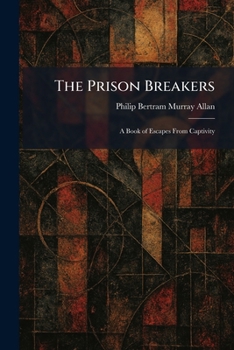
The Prison Breakers: A Book of Escapes From Captivity

Select Format
Select Condition 
Book Overview
"The Prison Breakers; A Book of Escapes From Captivity" is a compelling examination of some of the most daring and resourceful flights from confinement in history. Philip Bertram Murray Allan meticulously chronicles the stories of individuals who refused to be held, detailing their ingenious methods, psychological resilience, and the sheer bravery required to navigate the treacherous path to freedom.
The work explores a variety of contexts, from military prisoners seeking to rejoin their ranks to civilian captives facing seemingly insurmountable odds. Each narrative serves as a testament to the universal human drive for liberty, highlighting the strategic planning and physical endurance necessary to bypass stone walls, iron bars, and vigilant guards. By documenting these escapes, the author provides a fascinating window into the history of incarceration and the persistent creativity of the human spirit when faced with captivity.
Readers of historical biography and true adventure will find this collection particularly engaging, as it blends suspenseful storytelling with factual rigor. Through its focus on the thrill of the chase and the triumph of the escapee, the book remains a classic study of the art of the getaway and the enduring quest for personal freedom.
This work has been selected by scholars as being culturally important, and is part of the knowledge base of civilization as we know it. This work was reproduced from the original artifact, and remains as true to the original work as possible. Therefore, you may see the original copyright references, library stamps (as most of these works have been housed in our most important libraries around the world), and other notations in the work.
This work is in the public domain in the United States of America, and possibly other nations. Within the United States, you may freely copy and distribute this work, as no entity (individual or corporate) has a copyright on the body of the work.
As a reproduction of a historical artifact, this work may contain missing or blurred pages, poor pictures, errant marks, etc. Scholars believe, and we concur, that this work is important enough to be preserved, reproduced, and made generally available to the public. We appreciate your support of the preservation process, and thank you for being an important part of keeping this knowledge alive and relevant.
Customer Reviews
ThriftBooks® and the ThriftBooks® logo are registered trademarks of Thrift Books Global, LLC
