


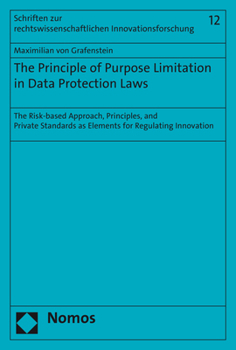
The Principle of Purpose Limitation in Data Protection Laws: The Risk-Based Approach, Principles, and Private Standards as Elements for Regulating Inn
No Customer Reviews

This thesis examines the principle of purpose limitation in data protection law from the perspective of regulating data-driven innovation. According to this approach, the principle of purpose limitation not only protects an individual's autonomy but simultaneously leaves sufficient room for data controllers to innovate when finding the best solution for protection. The first component of the principle of purpose limitation (i.e. to specify the purpose of data processing) is a precautionary protection instrument which obliges the controller to identify specific risks arising from its processing against all fundamental rights of the data subject. In contrast, the second component (i.e. the requirement to limit data processing to the preceding purpose) aims to control the risk caused by data processing that occurred at a later stage and adds to the risks which were previously identified. This approach provides an answer to the question of how the General Data Protection Regulation which does not only effectively protect an individual's autonomy but also helps controllers to turn their legal compliance into a mechanism that enhances innovation, should be interpreted with regard to all the fundamental rights of the data subject.
Format:Paperback
Language:English
ISBN:3848748975
ISBN13:9783848748976
Release Date:April 2018
Publisher:Nomos Verlagsgesellschaft
Length:675 Pages
Weight:1.98 lbs.
Dimensions:1.5" x 6.0" x 8.9"
Related Subjects
LawCustomer Reviews
0 rating
Copyright © 2026 Thriftbooks.com Terms of Use
| Privacy Policy | Do Not
Sell/Share My Personal Information | Cookie Policy | Cookie Preferences | Accessibility Statement
ThriftBooks® and the ThriftBooks® logo are registered trademarks of Thrift Books Global, LLC
ThriftBooks® and the ThriftBooks® logo are registered trademarks of Thrift Books Global, LLC
