


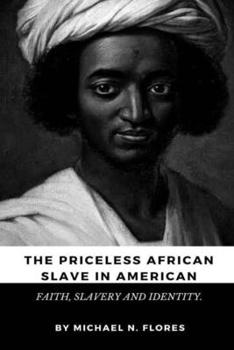
The Priceless African salve in American: Faith, Slavery and Identity
No Customer Reviews

Ayuba Suleiman Diallo is most known for his memoirs as a Muslim who was enslaved in colonial America and had to suffer the Atlantic slave trade.
Michael N. Flores published his biography, Some Memories of the Life of Job, in 1734. They remain one of the few primary sources on the Atlantic slave trade and slave life in eighteenth-century America to this day. Diallo was born in the country of Futa Toro in what is now Senegal in 1701. Diallo was up in relative affluence, having been born into a distinguished and devout family. By 1729, he was a young trader. That same year, he and his translator, Loumein, were kidnapped by Mandinka slave dealers, who sold him to the Royal African Company, the region's largest English slaving company. The firm then sold him to a ship captain, who transported him to Annapolis, Maryland, where he began his enslavement in the British colonies.Diallo was originally sent to the tobacco fields, but due to his lack of experience with strenuous physical labor, he was swiftly transferred to herding cattle. Diallo kept his religion disguised for a time until he was discovered by a youngster who found him praying to Allah. Slave owners tormented slaves who continued to follow their African faiths, notably Islam. Diallo attempted to flee his master in 1731 after being publicly humiliated for continuing to follow his faith but was apprehended and imprisoned in the Kent County, Maryland, courtroom. While in prison, he met Rev. Thomas Bluett, an attorney, judge, and missionary who was pleasantly pleased by Diallo's ability to read and write Arabic. He could also communicate in Wolof, which he translated for Bluett. Even though Bluett returned Diallo to his owner, he assisted Diallo in persuading the owner of his noble ancestry. Diallo also sent a letter to his father in Futa Toro in Arabic. Instead, it reached James Oglethorpe, the Royal African Company's director.
Diallo was purchased by Oglethorpe, who set him free and brought him to London to start a new life. Diallo socialized with London's social elite there.
Despite these connections, he still had to deal with slave hunters who wanted to kidnap him and sell him to other slave dealers. Bluett, who was in London at the time, was contacted. Concerned for Diallo's safety, Bluett solicited monies from London's upper crust, notably the Duke and Duchess of Montague, members of the royal family, to allow him to return to Futa Toro. In exchange, Diallo promised to let Bluett write his memoirs, which he only finished after arriving in West Africa.
In 1734.
Diallo returned to find that his father had died and that his wife had remarried. Diallo, on the other hand, was permitted to see his kids and stay in Futa Toro. Ironically, he went on to work for the Royal African Company as an interpreter and slave dealer until his death in 1773 at the age of 72. The slave memoirs that were popular with British and American abolitionists in the late eighteenth and early nineteenth centuries began with Diallo's memories, which Bluett published. His account is still seen as essential to comprehending the Atlantic slave trade.
Format:Paperback
Language:English
ISBN:B09SV45SYF
ISBN13:9798418913845
Release Date:January 1
Publisher:Independently Published
Length:26 Pages
Weight:0.11 lbs.
Dimensions:0.1" x 6.0" x 9.0"
Related Subjects
HistoryCustomer Reviews
0 rating
Copyright © 2026 Thriftbooks.com Terms of Use
| Privacy Policy | Do Not
Sell/Share My Personal Information | Cookie Policy | Cookie Preferences | Accessibility Statement
ThriftBooks® and the ThriftBooks® logo are registered trademarks of Thrift Books Global, LLC
ThriftBooks® and the ThriftBooks® logo are registered trademarks of Thrift Books Global, LLC
