


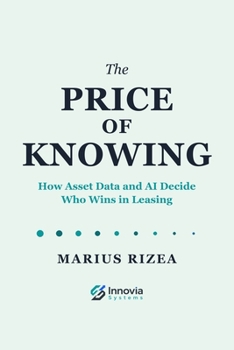
The Price of Knowing: How Asset Data and AI Decide Who Wins in Leasing
No Customer Reviews

Two levers move a leasing business. The first is the rate, and it is worked hard already. The second is what the lender actually knows about the asset, which has been slow to arrive and expensive to establish.
Five parties touch every financed asset, and each holds a different fragment of it. The maker knows what it is. The workshop knows what has been done to it. The insurer carries the risk without ever laying eyes on it. The customer knows how hard it has been worked. The funder knows what was paid, and little else. On every deal, each of them pays again to establish something another already knew.
The fragments are not the problem. The gaps between them are. A record gains value as it connects: each party that joins removes a duplicate verification for the others, and the asset stops being examined at two moments, origination and end of term, and starts being observable in between. That is where the second lever sits, and why the returns compound rather than add.
The harder constraint has not been the model. It has been the data, and who was allowed to read it. That changes by law. From February 2027 a battery must carry a passport any authorised party can read, on open standards, through an open exchange network. The law uses the phrase "without vendor lock-in". The registry behind it is already published, with a verified role for the firm in the middle and a rule forbidding it from selling a byte of what passes through. Interconnection is being written into the market as a condition, rather than sold into it as a product.
So the competition changes shape. The advantage goes less to whoever holds the best data, or trains the best model, than to whoever acts on it fastest, inside the window where the decision is still open. A model reading one fragment is worth little. The same model on a connected record earns its keep: cheaper origination, lower loss severity, fraud that becomes visible while it is still recoverable, and assets that were routinely declined becoming financeable. That holds whether the contract is an operating lease, a finance lease or hire purchase.
THE PRICE OF KNOWING is written for the people who have to make that work. It follows one ordinary transaction from the quoted rate to the shareholder's return, showing where a 269 basis point margin becomes 129, and why the identical deal returns thirteen per cent on one balance sheet and five on another. Then it opens out: what a lease actually is and the five ways the same six rights get divided; residual and credit risk, and why loss given default is a residual question; accounting and tax across five systems that reach independently for the same variable; the markets of continental Europe, the United Kingdom, the United States and Canada; who is legally entitled to an asset's data, and on what timetable; what that data makes possible once it arrives in time to change a decision; and what the AI Act actually does to a lessor.
Every figure carries its source and its date. Where the numbers are not public, the book says so instead of estimating. And it states, in advance, what would prove it wrong.
Written for analysts, product managers, credit and risk functions, treasury, and the investors who have to decide what a leasing book is worth.
Format:Paperback
Language:English
ISBN:B0HGN2FDZT
ISBN13:9798170077359
Release Date:August 2026
Publisher:Independently Published
Length:268 Pages
Weight:0.80 lbs.
Dimensions:0.6" x 6.0" x 9.0"
Customer Reviews
0 rating
Copyright © 2026 Thriftbooks.com
Terms of Use | Privacy Policy | Do Not Sell/Share My Personal Information | Cookie Notice | Cookie Preferences | Accessibility Statement
ThriftBooks ® and the ThriftBooks ® logo are registered trademarks of Thrift Books Global, LLC
ThriftBooks ® and the ThriftBooks ® logo are registered trademarks of Thrift Books Global, LLC
