


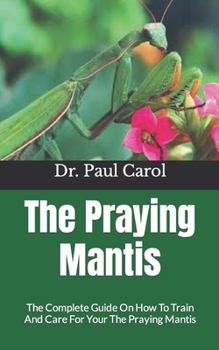
The Praying Mantis: The Complete Guide On How To Train And Care For Your The Praying Mantis
No Customer Reviews

The praying mantis may be a familiar insect commonly seen in late summer and fall. it's an extended body (about 7.5 cm, or 3 inches, in length), wings folded along the rear, and two pairs of long legs used for walking or running. The front legs are modified into prey-grasping structures held during a position that reminds some people of prayer, and thus the common name. the top is triangular in shape and possesses large compound eyes. In contrast to most species of insects, the mantis can move its head around freely--about 180 degrees. this enables the mantis to seem for prey, or danger, without having to maneuver its green or brown camouflaged body. It are often an ambush predator, expecting prey to maneuver within striking distance, or it can run quickly to attack. The front appendages, referred to as raptorial legs, are wont to seize prey. When at rest these legs fold into a "jackknife" position, but they're extended with amazing speed to grab prey. Spines along the leg help to carry captured prey. The mantis usually feeds during the day, but also will come to forage around artificial lights in the dark (usually these are adult males). Although some prey are stalked by the mantis, most are taken by "head-on" ambush. The mantis immobilizes captured prey by chewing on the neck first. Foods consist mostly of soft-bodied insects like flies and moths. Often, a mantis will serve a flower for insects that come for nectar. once in a while, a mantis may even capture and prey on a hummingbird that has come to a flower! A hungry female sometimes eats the top off of the male while they're mating. This cannibalistic behavior supposedly gives her a meal, and thus energy for the fertilized eggs she soon will lay. Eggs are laid during a frothy material that eventually hardens into a foam-like structure called an ootheca that's attached to surfaces like buildings or branches. The young all hatch at about an equivalent time, looking like miniature adults. These young may begin to prey on one another, so it's useful for them to disperse quickly after leaving the ootheca. The praying mantis is taken into account to be a useful garden animal to assist control other insects, so there's a marketplace for them and their eggs. they typically don't bite humans, damage furnishings, or spread diseases.
Format:Paperback
Language:English
ISBN:B09KDYQXXG
ISBN13:9798755264808
Release Date:January 1
Publisher:Independently Published
Length:28 Pages
Weight:0.08 lbs.
Dimensions:0.1" x 5.0" x 8.0"
Customer Reviews
0 rating
Copyright © 2026 Thriftbooks.com
Terms of Use | Privacy Policy | Do Not Sell/Share My Personal Information | Cookie Notice | Cookie Preferences | Accessibility Statement
ThriftBooks ® and the ThriftBooks ® logo are registered trademarks of Thrift Books Global, LLC
ThriftBooks ® and the ThriftBooks ® logo are registered trademarks of Thrift Books Global, LLC
