


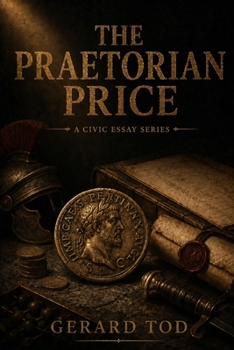
The Praetorian Price: A Civic Essay Series
No Customer Reviews

THE PRICE OF PROXIMITY IS NOW PUBLIC. In 193 AD, the Praetorian Guard murdered an emperor, climbed the walls of its own camp, and auctioned Rome to the highest bidder. Two men bid against each other, guardsman by guardsman, until Didius Julianus won at twenty-five thousand sesterces a head. He held the throne for sixty-six days. In 2026, a sitting president's media company began selling Wall Street trading firms early access to his own public statements, for up to one hundred thousand dollars a month. His family's cryptocurrency ventures generated, by independent estimate, roughly two point three billion dollars, drawn substantially from outside investors who lost a comparable sum on the other side of the same trades. Securities lawyers called the arrangement insider trading by another name. The regulator asked to investigate declined to comment. In The Praetorian Price, Gerard Tod turns to the auction on the Palatine, the sale of church office, the purchase of British army commissions, and the century-old law written after the last time American markets rewarded whoever stood closest to power, to ask a plain question: what does a republic look like once access to its own presidency has a sticker price, and who is actually paying it. This is not a book asking readers to master securities law or Roman history. It asks five simpler questions: Who is selling. What is being sold. Who set the price. Who is buying it. And what happens when the money cannot purchase the one thing it was supposed to.
Format:Paperback
Language:English
ISBN:B0HD17774V
ISBN13:9798190870251
Release Date:August 2026
Publisher:Independently Published
Length:42 Pages
Weight:0.15 lbs.
Dimensions:0.1" x 6.0" x 9.0"
Customer Reviews
0 rating
Copyright © 2026 Thriftbooks.com
Terms of Use | Privacy Policy | Do Not Sell/Share My Personal Information | Cookie Notice | Cookie Preferences | Accessibility Statement
ThriftBooks ® and the ThriftBooks ® logo are registered trademarks of Thrift Books Global, LLC
ThriftBooks ® and the ThriftBooks ® logo are registered trademarks of Thrift Books Global, LLC
