


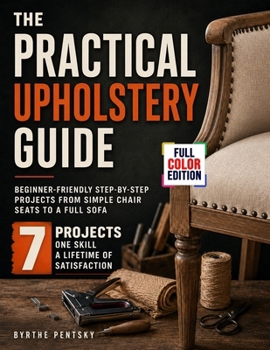
The Practical Upholstery Guide: Beginner-Friendly Step-by-Step Projects from Simple Chair Seats to a Full Sofa
No Customer Reviews

Seven projects carry you from a removable seat pad to the coordinated structure of a three-seat sofa. Each one adds a manageable demand: tighter corners, cleaner piping, stronger support, shaped padding, visible edges, larger panels, and more deliberate planning. The Practical Upholstery Guide is written for the first-time upholsterer who wants to understand what sits beneath the show fabric, not merely hide it. Before a staple is driven, you learn to read a frame, judge whether it is sound, estimate fabric and time, arrange a workable bench, and choose tools without overspending. WHAT THE SEVEN-PROJECT SEQUENCE BUILDSStrip a piece methodically, preserve useful original layers, and recognise when a damaged frame needs repair or retirement.Fit fabric under even tension, work corners without bulky folds, and use staples, tacks, or trim where each fastening belongs.Cut panels accurately, set up a sewing machine for heavier cloth, make piping, match repeats, and correct seams that wander.Rebuild support with webbing, hessian, foam, wadding, or coil springs, then test the seat before the cover conceals the work.Shape domed and curved surfaces, handle convex and concave areas, and place shallow or multi-point buttoning with control.Assess loose joints, corner blocks, rails, arm posts, and back uprights before committing materials to a larger frame.Plan symmetry, yardage, cushion configuration, panel order, workspace, and help for the final three-seat sofa.
The projects begin with a simple drop-in seat pad, then move through a piped box cushion, a rebuilt dining chair seat, an upholstered footstool, a slip-seat occasional chair, and a fully upholstered wingback armchair. The final sofa asks you to combine those earlier techniques across a wider frame, where sequence and symmetry matter as much as individual seams. FROM THE FRAME OUTWARD This is practical reupholstery grounded in the decisions that determine whether finished furniture sits square and wears well. Fabric selection is tied to use and pattern direction. Foam density, wadding, webbing grades, spring height, piping cord, thread, and small notions are introduced where their purpose becomes clear. Troubleshooting stays close to the work. If a cushion twists, gathers bunch, a corner puckers, a button loosens, a seat sags, or a panel pulls out of line, the text traces the visible fault back to the construction step most likely to have caused it. Care guidance and project records help you maintain the piece and remember what is hidden beneath its cover. The progression is substantial without pretending that every object should be saved. Safety checks, realistic estimates, tool maintenance, and stop-and-reassess points appear throughout. By the time the larger builds arrive, you are not following isolated instructions; you are planning an upholstery sequence and understanding why each layer comes next. The frame tells you what it needs. This book teaches you how to read it.
The projects begin with a simple drop-in seat pad, then move through a piped box cushion, a rebuilt dining chair seat, an upholstered footstool, a slip-seat occasional chair, and a fully upholstered wingback armchair. The final sofa asks you to combine those earlier techniques across a wider frame, where sequence and symmetry matter as much as individual seams. FROM THE FRAME OUTWARD This is practical reupholstery grounded in the decisions that determine whether finished furniture sits square and wears well. Fabric selection is tied to use and pattern direction. Foam density, wadding, webbing grades, spring height, piping cord, thread, and small notions are introduced where their purpose becomes clear. Troubleshooting stays close to the work. If a cushion twists, gathers bunch, a corner puckers, a button loosens, a seat sags, or a panel pulls out of line, the text traces the visible fault back to the construction step most likely to have caused it. Care guidance and project records help you maintain the piece and remember what is hidden beneath its cover. The progression is substantial without pretending that every object should be saved. Safety checks, realistic estimates, tool maintenance, and stop-and-reassess points appear throughout. By the time the larger builds arrive, you are not following isolated instructions; you are planning an upholstery sequence and understanding why each layer comes next. The frame tells you what it needs. This book teaches you how to read it.
Format:Paperback
Language:English
ISBN:B0HGBBFMFV
ISBN13:9798194588602
Release Date:August 2026
Publisher:Independently published
Length:138 Pages
Weight:0.75 lbs.
Dimensions:11.0" x 0.3" x 8.5"
Customer Reviews
0 rating
Copyright © 2026 Thriftbooks.com
Terms of Use | Privacy Policy | Do Not Sell/Share My Personal Information | Cookie Policy | Cookie Preferences | Accessibility Statement
ThriftBooks ® and the ThriftBooks ® logo are registered trademarks of Thrift Books Global, LLC
ThriftBooks ® and the ThriftBooks ® logo are registered trademarks of Thrift Books Global, LLC
