


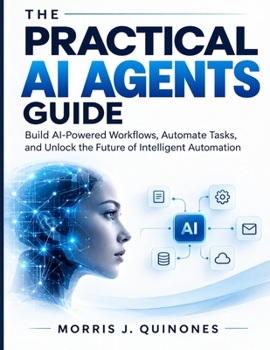
The Practical AI Agents Guide: Build AI-Powered Workflows, Automate Tasks, and Unlock the Future of Intelligent Automation

Have you experimented with AI tools that can generate impressive answers-but still leave you doing the actual work?
Do AI agents sound powerful in theory, yet become confusing when you try to connect models, tools, data, memory, and real business tasks? Are you tired of demonstrations that show an agent working once, but never explain how to make it reliable?
The Practical AI Agents Guide shows you how to move beyond prompts and build AI-powered workflows designed to perform useful work.
You'll learn how to turn repetitive knowledge work into structured automation, connect AI to tools and business systems, manage information and memory, coordinate multi-step tasks, and introduce human approval where autonomous action needs control.
From asking AI for answers to designing systems that perform useful work.
From isolated prompts to structured workflows.
From trial-and-error to deliberate agent design.
From unreliable outputs to tested, observable execution.
This practical guide takes you through the full journey-from identifying tasks suitable for agentic automation to designing, building, testing, securing, deploying, and improving working AI workflows.
You'll learn how to:
Identify business and professional tasks that can benefit from AI agents
Break complex knowledge work into manageable automated workflows
Choose models, tools, platforms, and architectures for different requirements
Engineer effective instructions and structured outputs
Connect agents to APIs, files, applications, and external tools
Design memory and knowledge-retrieval systems
Build research, productivity, document, data, email, scheduling, sales, marketing, and customer-service workflows
Coordinate multi-step and multi-agent processes
Add human approval and decision controls
Handle failures, retries, validation, state, and controlled execution
Protect agents against prompt injection, excessive permissions, credential exposure, and sensitive-data leakage
Test workflows against realistic tasks and failure cases
Trace, troubleshoot, and evaluate production behavior
Manage model costs, token usage, latency, concurrency, and tool calls
Connect agents with CRM, ERP, communication, project-management, and knowledge systems
Scale individual automations into a maintainable portfolio of intelligent workflows
The focus is not on making an agent look impressive in a demonstration. It is on making automation useful, repeatable, controlled, measurable, secure, and maintainable.
That means confronting the problems that appear after the first successful run: incorrect actions, bad inputs, failed tools, unreliable outputs, integration defects, security risks, unexpected costs, and workflows that become difficult to maintain.
For beginners, this book provides a practical path through unfamiliar AI-agent concepts without assuming deep engineering knowledge. For professionals, entrepreneurs, freelancers, and aspiring AI builders, it provides a framework for turning AI capabilities into repeatable workflows that support real work.
An AI agent is valuable not because it can produce an impressive response, but because it can reliably complete useful work within defined boundaries.
If you are ready to move beyond disconnected prompts and shallow demonstrations, The Practical AI Agents Guide gives you a practical path from using AI to building AI-powered automation that works.
Start building workflows that do more than answer questions. Build AI systems designed to perform meaningful work.
Customer Reviews
ThriftBooks ® and the ThriftBooks ® logo are registered trademarks of Thrift Books Global, LLC
