


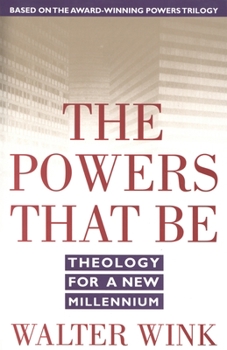
The Powers That Be: Theology for a New Millennium


Select Format
Select Condition 
Book Overview
In our fast-paced secular world, God and theology are second-class citizens. Money, politics, sports, and science seem better suited to the hard realities of our world. As the church steeple has been eclipsed by the skyscraper as the centerpiece of the urban landscape, so has the divine realm been set aside in favor of more immediate human experience. One sad consequence of this shift is the loss of spiritual and theological bearings, most clearly evident in our inability to understand or speak about such things. If the old way of viewing the universe no longer works, something else has to replace it. The Powers That Be reclaims the divine realm as central to human existence by offering new ways of understanding our world in theological terms. Walter Wink reformulates ancient concepts, such as God and the devil, heaven and hell, angels and demons, principalities and powers, in light of our modern experience. He helps us see heaven and hell, sin and salvation, and the powers that shape our lives as tangible parts of our day-to-day experience, rather than as mysterious phantoms. Based on his reading of the Bible and analysis of the world around him, Wink creates a whole new language for talking about and to God. Equipped with this fresh world view, we can embark on a new relationship with God and our world into the next millennium.
Format:Paperback
Language:English
ISBN:0385487525
ISBN13:9780385487528
Release Date:April 1999
Publisher:Harmony
Length:240 Pages
Weight:0.74 lbs.
Dimensions:0.6" x 5.5" x 8.1"
Customer Reviews
3 ratings
Excellent philosophical basis for activists
Published by Thriftbooks.com User , 22 years ago
I bought this book when it was recommended as "essential reading" at a peacemaking workshop. I found it invaluable in putting to rest my tendencies to demonize others, especially those in power, and to forego action because I was not blameless. This book proved the basis for me to regain my optimism about the possibility of acting in the world--acknowledging reality while remaining optimistic for change and social justice. I went out and bought 12 copies to give to influencers of policy, from Bill Clinton to fellow members of my Peace Covenant group. You don't have to believe in any particular dogma to get a lot out of this overview of ways to look at the world and to engage with it. I've already run out of copies and hope that more people read this book.
A profoundly important book
Published by Thriftbooks.com User , 23 years ago
If I had to pick the best theology books of the past twenty-five years, Walter Wink's *Powers that Be* would be close to the top of the list. It does nothing less than revolutionize the way Christians have come to think of their role in the world. But when I say "revolutionize," what I really mean--and this is Wink's contention as well--is that it "reminds" Christians of the original message brought by Jesus and accepted by the early Church. And that message is that nonviolence, not violence, is not only what God expects, but also what ultimately works in the world.Wink argues that humans live under "domination systems"--the "powers and principalities that be." These are the structural and ideological institutions that manipulate our minds, lives, and activities, reduce our freedom, and retard our flourishing. As Christians, we're called to resist them without buying into the "myth of redemptive violence"--the centuries' old chestnut that violence is the only kind of force that works, and that because it works it justifies itself. Jesus showed an alternative way--the path of nonviolent resistance.In examining nonviolent resistance, Wink is masterful. He persuasively destroys the stereotype of nonviolence as a turn-the-other-cheek passivity by exploring what Jesus really meant when he advocated cheek-turning or walking the second mile. Along the way, he offers one of the most insightful analysis of the post-Jesus "just war doctrine" I've ever read. Wink is realistic enough to not completely reject the doctrine. But he does suggest that we quit using it as a justification for war and begin thinking of it instead in terms of "violence-reduction criteria."An amazing book that every Christian ought to read and meditate on, particularly now that the dogs of war are baying loudly. I give it ten stars.
Finding evil in our midst
Published by Thriftbooks.com User , 24 years ago
Walter Wink's groundbreaking work gives us a new way to examine the ideas of evil and salvation in the Bible. Wink suggests that the Powers and Principalities mentioned in the New Testament are the psychological underpinnings of complicated systems -- that is, that every corporation, church, government, etc., has its own personality that tends to take over no matter what the individual people involved. All these powers have a God-given purpose, but when they serve their own ends rather than human beings, they become demonic, and it is Christians' responsibility to confront them through nonviolent action and prayer.Wink writes stirringly and concisely. He quotes frequently from Scripture, and uses examples from contemporary life such as Martin Luther King, Jr. and Nelson Mandela. Wink seeks to return the church to a foundation in Scripture rather than the accretions of Christendom and arcane theological theories. A must -read for any serious, thinking Christian who wants to live their faith and not just profess it.
Copyright © 2026 Thriftbooks.com Terms of Use
| Privacy Policy | Do Not
Sell/Share My Personal Information | Cookie Policy | Cookie Preferences | Accessibility Statement
ThriftBooks® and the ThriftBooks® logo are registered trademarks of Thrift Books Global, LLC
ThriftBooks® and the ThriftBooks® logo are registered trademarks of Thrift Books Global, LLC
