


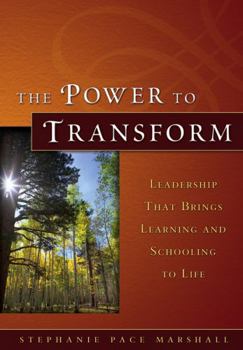
The Power to Transform: Leadership That Brings Learning and Schooling to Life

Select Format
Select Condition 
Book Overview
In this important new book, Stephanie Pace Marshall argues that by focusing on reforming the contents of schooling and not transforming the context and conditions of learning, we have created false proxies for learning and eroded the potentially vibrant intellectual life of our schools. Finishing a course and a textbook has come to mean achievement. Listening to a lecture has come to mean understanding. Getting a high score on a standardized test has come to mean proficiency. Credentialing has come to mean competence. To educate our children wisely requires that we create generative learning communities, by design. Such learning communities have their roots in meaning, not memory; engagement, not transmission; inquiry, not compliance; exploration, not acquisition; personalization, not uniformity; interdependence, not individualism; collaboration, not competition; and trust, not fear.
Format:Hardcover
Language:English
ISBN:078797501X
ISBN13:9780787975012
Release Date:March 2006
Publisher:Jossey-Bass
Length:272 Pages
Weight:1.07 lbs.
Dimensions:1.0" x 6.2" x 9.3"
Customer Reviews
5 ratings
Must reading for those serious about improving schools . . .
Published by Thriftbooks.com User , 18 years ago
Most education reform today consists of tinkering around the edges of an essentially broken model, of adding more of the same and, inexplicably, expecting things to get better. We are long overdue for a new vision. The Power to Transform provides exactly that. Stephanie Pace Marshall's impassioned, deeply thoughtful and groundbreaking book on transformative leadership for schooling and learning is easily among the top five books on education currently in print, and the only one I know that gives readers a powerful vision for the future and for true systemic change. It is a guide for those who would lead a revolutionary movement to fundamentally transform American education, even from within their own schools. Those who have read Thomas Friedman's The World is Flat understand the need for radical change in our nation's schools if the United States is to remain a creative and contributing society among world nations, equal to the challenges that lie ahead. To be successful in this new world, young people need different skills than preceding generations, an engaged relationship to learning (sorely lacking in today's often lackluster and out of touch schools) and ways to connect their capacities and interests to the work that needs doing in the world. Dr. Marshall has tapped the disconnect between what is and what needs to be in education in a powerful and compelling way, through story and through a well-reasoned argument for change. She also provides questions to guide that process at both the grass roots level and within the halls of power. Endorsements by Howard Gardner, Parker Palmer, Margaret Wheatley and Robert Galvin speak to the importance of this book; it is truly a seminal work and a must read for anyone interested in making schools better for students, for teachers and for the world. I used The Power to Transform last year for a seminar I conduct at Northwestern University, and I plan to use it again this fall. The book was a huge success, and I'm looking forward to the rich conversations and practical school level applications it generates within my next seminar class. I cannot recommend it highly enough! And I love her letter to her grandchildren. I, too, have it up in my office and share it widely.
Kirsten Olson, author of The Wounds of Schooling
Published by Thriftbooks.com User , 18 years ago
So many books on school leadership--haven't we all slogged our way through them?--are manifestos from those who tell us with great certainty and authority what we must "know": how to realign building resources, institute new management beliefs, and instrumentally refocus strategic goals. Again and again these books disappoint. They are unreal technical manuals that do not address the deep, dysfunctional paradigms that underlie our current educational system: that students are containable, defined units to be filled with knowledge, that competition and external prodding inspires profound learning, that learning itself is linear and predictable. Using narrative--the power of story--and her own experiences of being transformed through leading, Marshall proposes a new model of generative school learning based on abundance. (So little in our educational system is based on an assumption of abundance, the idea itself is almost startling.) Marshall says that instead of regarding the learner reductively and mechanistically, as we tend to in our day-to-day interactions and in larger educational policy, she invites us to rethink our work and learn to tell a new story about ourselves, one that reflects that: Learning is shaped by personal purpose Ability is multidimensional Holistic engagement of all the learner's senses and feelings is essential for real inquiry (p. 81). This doesn't sound like many high schools I visit every week, unfortunately, where learning by compulsion, fear, or threat are the veiled order of the day. My hope is that Marshall's book will find its way to many school leaders, those who are ready to look deeply into the fundamental assumptions that underlie their work and the structures of education in America. Especially useful is Marshall's table comparing "current reductive" educational ideas and a new "generative and personalized" vision of learning, teaching and curriculum (pp. 219-225). The table is a remarkably clear, concise analysis of what is, and what might be. Finally, Marshall offers some good words to live by, for any leader anywhere. In a letter to her grandchildren she reminds them that one's life is about: Your integrity, not your position Your voice, not your power Your name, not your title Your calling, not your career Your legacy, not your success (p. 214). I have these words up on the wall of my office, and I visit with them often. Marshall is wise, inspiring and refreshing.
Design for a Very Different Future for Learning and Schooling
Published by Thriftbooks.com User , 19 years ago
In The Power to Transform, Stephanie Pace Marshall poses the question of what it will take to create a generative and life-affirming system of learning and schooling that liberates the goodness and genius of all children and invites and nurtures the power and creativity of the human spirit for the world. The question stirs deep and often latent passion in those of us who are devoting our professional lives to education. What would it take? How does one even begin to conceptualize the journey let alone chart a course toward such a vision? The Power to Transform offers those who are willing to look beyond the myriad of barriers to the possibility of a very different future. Books on leadership for systemic reform typically offer direction for aligning and connecting the functions of school systems with visions that often speak eloquently to life-long learning, productive work, and global citizenship. Alignment and connection are complex and necessary steps but they do not go far enough. Marshall is dead on labeling the goal of much of what is characterized as reform and transformation as leading us to false proxies for learning--high scores on high stakes tests. As educators we know these limited snapshots are far from evidence of deep understanding, internal authority for learning, and the ability to apply learning in multiple contexts that are necessary to achieve these visions. So what will it take? Direction, design, rich and compelling stories that offer evidence that such learning environments are possible, and evidence of success from students who have experienced this fundamentally different approach to learning and schooling. The Power to Transform presents a powerful argument for why leaders cannot accept false proxies for learning and offers an alternative future for learning and schooling that embraces the learning competencies needed to thrive in a complex, interdependent, and continuously changing world. Principles of design offer direction, not prescription, that allow for contextualizing processes and structures to operationalize the vision. Marshall draws heavily from two decades of experience in leading the Illinois Mathematics and Science Academy. She describes a learning journey where she and her staff are learning their way into creating a desired future. The stories of her students who have experienced a more generative and life-affirming system of learning at IMSA speak to thriving in schooling, work, and their commitment to work toward a more sustainable future for our world.
Burnie Bristow, MA, NBCT-Doctoral Student Pepperdine University
Published by Thriftbooks.com User , 19 years ago
This book is the truth, the whole truth and nothing but the truth regarding why and how to transform public schooling in the United States. Written by a titan in the field of education, the founding director of the Illinois Mathematics and Science Academy, Dr. Stephanie Pace Marshall, the book is a powerful and compelling thesis on how recent advances in research and technology has changed the way we need to think about schooling. Schools have the arduous task of preparing students to enter into a world that is changing at an unprecedented pace. So how are we doing in our quest to prepare students to be active participants in an information economy? Bill Gates says "today's high schools are obsolete! In the words of Dr. Marshall... The current context of schooling: "Many of our children have become schooling disabled in a learning-abundant universe. They are...losing heart. They have no way of knowing that they have un-intentionally been shortchanged. Teachers too are feeling loss. They (teachers), feeling compelled to teach to the test, soon lose their passion and enthusiasm for their discipline and for teaching. Many...policymakers, and parents....are losing heart. They do not know where or how to begin the conversation to transform it (schooling)." Beginning a new conversation: "Grounding a new story of learning and schooling in a holistic new narrative will enable our children to re-claim their deepest selves, embrace their natural learning potentials, and reweave their connection to one another, the human family, our planet, and web of life. The need has never been greater." Follow Dr. Marshall on a journey to "A New Learning Landscape"...The Aspen Grove Center for Inquiry and Imagination... a "New School" where there are no bells to signal the end or beginning of classes, the curriculum is not textbook driven, textbooks are just one resource, the larger community is engaged in learning, learning is collaborative, creative and exploratory! IMSA represents the best practices of what the knowledge building scholars, i.e., J. Lave, E. Wenger J. Bransford, C. Bereiter, J. King, L. Polin, M. Riel, have been writing about. Under the leadership of Dr. Marshall, an education trailblazer extraordinaire, something special is happening at IMSA...read all about, and you will begin to equip yourself with the Power to Transform Learning and Schooling.
Learning and Schooling: A Call for a Radical New Story
Published by Thriftbooks.com User , 19 years ago
Big new ideas are rare in public education. I am finding myself compelled to re-examine more carefully many assumptions about school reform in the context of this book. Marshall's "The Power to Transform: Leadership That Brings Learning and Schooling to Life," is a truly seminal work of theory and praxis for education. While the book is deceptively small, it is not for the faint hearted or those in search of quick fixes - it is personal, extensively argued and well documented. With laser-like intensity and passion, Marshall offers us deeply thoughtful reasons for our nation's 21st century dysfunctions in public education. Marshall then presents a powerful call for a radical new story of learning and schooling - one that is grounded systemically in life processes, rather than in reductive, Newtonian determinism as is presently the case. Hers is a personal story as well. With deep understanding of the human condition as well as organizational dynamics, Marshall's magnum opus on learning and schooling is a context for systemic, organizational change in schools that ranges from student-teacher dynamics to the highest levels of public policy, by design. Illustrative personal anecdotes from her lifetime of work with students and teachers lighten things up, as does a thoughtful letter to her grandchildren at the end. But reader beware, this is no "formula for success." Rather, the author calls each of us to arouse our own hearts and voices in community. Our task is to co-create emerging personal and organizational identities that are grounded in collaboration and inquiry, to liberate the goodness and genius of children - for the world. The ideas in this book represent a new context for change that is provocative and, hopefully, even dangerous to the status quo. Those who have worked in student-centered educational settings that have long occupied the margins of public schools will likely find Marshall's work highly compatible with their own their best educational thinking and practices. Those who pay obeisance to the rote eternal motion of yesterday and most of today's command and control-based thinking and bureaucratic schools, or even embrace much of what passes today for school reform, should take note: In order to take away the best from this book you may need to give yourself permission to aside your expertness in order to see with a beginner's mind the potential that Marshall creates for us to imagine and enact -- a truly new day for learning and schooling in the new millennium, by design.
Copyright © 2026 Thriftbooks.com Terms of Use
| Privacy Policy | Do Not
Sell/Share My Personal Information | Cookie Policy | Cookie Preferences | Accessibility Statement
ThriftBooks® and the ThriftBooks® logo are registered trademarks of Thrift Books Global, LLC
ThriftBooks® and the ThriftBooks® logo are registered trademarks of Thrift Books Global, LLC
