


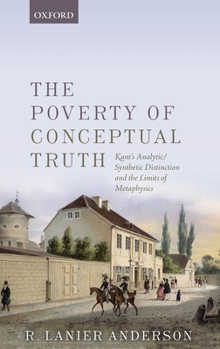
Poverty of Conceptual Truth: Kant's Analytic/Synthetic Distinction and the Limits of Metaphysics
No Customer Reviews

Select Format
Select Condition 
Book Overview
The Poverty of Conceptual Truth is based on a simple idea. Kant's distinction between analytic and synthetic judgments underwrites a powerful argument against the metaphysical program of his Leibnizian-Wolffian predecessors--an argument from fundamental limits on its expressive power. In that
tradition, metaphysics promised to reveal the deep rational structure of the world through a systematic philosophy consisting of strictly conceptual truths, which flow from a logically perspicuous relation of 'containment' among concepts. That is, all truths would be 'analytic, ' in Kant's sense.
Kant's distinction shows to the contrary that far reaching and scientifically indispensable parts of our knowledge of the world (including mathematics, the foundations of natural science, all knowledge from experience, and the central principles of metaphysics itself) are essentially synthetic and
could never be restated in analytic form. Thus, the metaphysics of Kant's predecessors is doomed, because knowledge crucial to any adequate theory of the world cannot even be expressed in the idiom to which it restricts itself (and which was the basis of its claim to provide a transparently rational
account of things). Traditional metaphysics founders on the expressive poverty of conceptual truth. To establish these claims, R. Lanier Anderson shows how Kant's distinction can be given a clear basis within traditional logic, and traces Kant's long, difficult path to discovering it. Once analyticity is framed in clear logical terms, it is possible to reconstruct compelling arguments that
elementary mathematics must be synthetic, and then to show how similar considerations about irreducible syntheticity animate Kant's famous arguments against traditional metaphysics in the Critique of Pure Reason.
tradition, metaphysics promised to reveal the deep rational structure of the world through a systematic philosophy consisting of strictly conceptual truths, which flow from a logically perspicuous relation of 'containment' among concepts. That is, all truths would be 'analytic, ' in Kant's sense.
Kant's distinction shows to the contrary that far reaching and scientifically indispensable parts of our knowledge of the world (including mathematics, the foundations of natural science, all knowledge from experience, and the central principles of metaphysics itself) are essentially synthetic and
could never be restated in analytic form. Thus, the metaphysics of Kant's predecessors is doomed, because knowledge crucial to any adequate theory of the world cannot even be expressed in the idiom to which it restricts itself (and which was the basis of its claim to provide a transparently rational
account of things). Traditional metaphysics founders on the expressive poverty of conceptual truth. To establish these claims, R. Lanier Anderson shows how Kant's distinction can be given a clear basis within traditional logic, and traces Kant's long, difficult path to discovering it. Once analyticity is framed in clear logical terms, it is possible to reconstruct compelling arguments that
elementary mathematics must be synthetic, and then to show how similar considerations about irreducible syntheticity animate Kant's famous arguments against traditional metaphysics in the Critique of Pure Reason.
Format:Hardcover
Language:English
ISBN:0198724578
ISBN13:9780198724575
Release Date:March 2015
Publisher:Oxford University Press (UK)
Length:428 Pages
Weight:1.72 lbs.
Dimensions:1.2" x 9.3" x 6.2"
Related Subjects
PhilosophyCustomer Reviews
0 rating
Copyright © 2026 Thriftbooks.com Terms of Use
| Privacy Policy | Do Not
Sell/Share My Personal Information | Cookie Policy | Cookie Preferences | Accessibility Statement
ThriftBooks® and the ThriftBooks® logo are registered trademarks of Thrift Books Global, LLC
ThriftBooks® and the ThriftBooks® logo are registered trademarks of Thrift Books Global, LLC
