


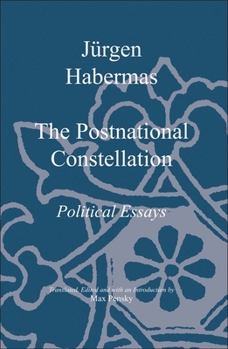
The Postnational Constellation: Political Essays

Select Format
Select Condition 
Book Overview
Does a global economy render the traditional nation-state obsolete? Does globalization threaten democratic life, or offer it new forms of expression? What are the implications of globalization for our understanding of politics and of national and cultural identities? In The Postnational Constellation , the leading German philosopher and social theorist J?rgen Habermas addresses these and other questions. He explores topics such as the historical and political origins of national identity, the catastrophes and achievements of "the long twentieth century," the future of democracy in the wake of the era of the nation-state, the moral and political challenges facing the European Union, and the status of global human rights in the ongoing debate on the sources of cultural identity. In their scope, critical insight, and argumentative clarity, the essays in The Postnational Constellation present a powerful vision of the contemporary political scene and of the challenges and opportunities we face in the new millennium. Those unfamiliar with Habermas's theoretical work will find in this volume a lucid and engaging introduction to one of the world's most influential thinkers. For readers familiar with Habermas's writings, The Postnational Constellation provides an invaluable application of his social and political theories to current political realities.
Format:Paperback
Language:English
ISBN:0745623522
ISBN13:9780745623528
Release Date:December 2000
Publisher:Polity Press
Length:216 Pages
Weight:0.62 lbs.
Dimensions:0.7" x 6.0" x 8.9"
Age Range:18 years and up
Grade Range:Postsecondary and higher
Customer Reviews
1 rating
Gets me interested in political philosophy
Published by Thriftbooks.com User , 25 years ago
I started noticing the works of Habermas because of his discourse ethics and its affinity with Kant's position. I never really had much interests in political / social philosophy (e.g. Locke, Hobbes, Marx, Weber, Freud, etc.) but this book changed me.The issue addressed by the keynote essay 'Postnational Constellation' explores the problem of the possibility of democracy in the process of globalization (esp. in Europe) where the traditional power of the nation states-- the traditional home of democracy-- continues to decline. While this might not be a very important problem say 50 years from now, the analysis is very interesting to me because:1. It emphasizes the importance of 'normative basis' in social-political debates. 2. It incorporates many insightful (at least to me) observations of empirical historical trends with normative considerations. 3. Habermas is a real thinker!After reading the book, which also includes a short summary of his account of the history of the philosophical idea of modernity and a short essay concerning human rights among other works, I am now interested in Habermas' social / political theory as expounded in his other books Facts and Norms and the Inclusion of Others.A side-note: Habermas' shorter essay Against Human Cloning is not as well-argued as other essays in the collection.
Copyright © 2026 Thriftbooks.com
Terms of Use | Privacy Policy | Do Not Sell/Share My Personal Information | Cookie Policy | Cookie Preferences | Accessibility Statement
ThriftBooks ® and the ThriftBooks ® logo are registered trademarks of Thrift Books Global, LLC
ThriftBooks ® and the ThriftBooks ® logo are registered trademarks of Thrift Books Global, LLC
