
Skip to content
Scan a barcode
Scan
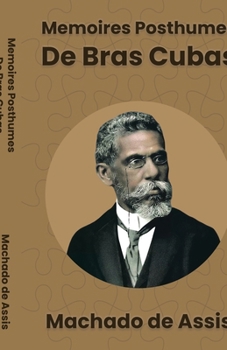
Hardcover Posthumous Memoirs of Brás Cubas Book

ISBN: 1631495321

ISBN13: 9781631495328

Posthumous Memoirs of Brás Cubas

Select Format

Select Condition ThriftBooks Help Icon

Recommended

Format: Hardcover

Condition: Very Good

$14.99
Save $12.96!
List Price $27.95
Almost Gone, Only 1 Left!
Save to List

Book Overview

"I passed away at two o'clock in the afternoon on a Friday in August in 1869, in my beautiful mansion in the Catumbi district of the city." So begins Machado de Assis's Posthumous Memoirs of Br?s Cubas, told eerily from beyond the grave. First appearing in Brazil in 1881, this remarkably experimental novel was never intended by its author to be a popular "run-of-the-mill-novel."

Joaquim Maria Machado de Assis, the son of a mulatto father and a washerwoman, and the grandson of freed slaves, was not, originally, expecting literary encomiums in his lifetime, especially not for Br?s Cubas. And yet, his prodigious output of novels, plays, and stories would influence generations of South American writers. Now, with this coruscating new translation of one of his most compelling novels, esteemed translators Margaret Jull Costa and Robin Patterson reveal a pivotal moment in Machado's career, as his flights of the surreal became his literary hallmark.

In eloquent, contemporary prose, Costa and Patterson breathe new life into the dynamic character of Br?s Cubas and reveal the vivid, tempestuous Rio de Janeiro of his time. The recently deceased Cubas narrates his life story, admitting glibly: "I am not so much a writer who has died, as a dead man who has decided to write." His life, therefore, is relayed out of order, beginning with his funeral, and then stepping back to offer "a brief genealogical sketch." An enigmatic, amusing and frequently insufferable anti-hero, Cubas describes his childhood spent tormenting household slaves and meddling cheekily in adult affairs, through his bachelor years navigating his own torrid affairs, up to his final days obsessing over nonsensical poultices.

Fantastical in structure and enthralling in tone, Posthumous Memoirs of Br?s Cubas is a deeply human story of a somber life--how much of it reflects the author's own personality we will never know. At once a work of uproarious mockery and great sympathy, this is Machado de Assis at his most pathbreaking: an incisive observer of the human condition, and a founding father of modernist fiction.

Customer Reviews

5 ratings

o meu brasil!

What a lovely, ironic tale, told from beyond the grave, of a successful Brazilian's life in the 19th century.

"Lifelong Wastrel Kicks a Goal at Last"

Brazil has produced a number of wonderful novels. I can name "Rebellion in the Backlands" by Euclides da Cunha, "The Devil to Pay in the Backlands" by João Guimaraes Rosa, "The Tent of Miracles" and "Gabriela; Clove and Cinnamon" by Jorge Amado, and "The Three Marias" by Rachel de Queiroz, but these are only a few. You have to add to this list at least a couple novels by J. M. Machado de Assis, Brazil's greatest writer of the 19th century, (he died in 1908) and one of the greatest writing anywhere at that time. EPITAPH OF A SMALL WINNER would be on that list for sure. I can hear you say, "Can you really compare this fellow to writers like Dostoevsky, Tolstoy, Balzac, Zola, Melville, Austen, or Eliot ?" My answer would be "yes" and "no". That's because I like definite answers. Sorry, just kidding. I would say "no" because Machado de Assis doesn't write like any of the others. His style is unique and his choice of perspective also. He is the opposite of a realist. He never hits you over the head with any serious descriptive narrative. His characters speak throughout. So, how could you compare him effectively with the others ? But, I would say "yes" because he is a master of subtle story telling, of wit, satire, and irony. This novel, like his others, does not resemble any other work. He is certainly among the greats. Braz Cubas, the narrator of the novel, is already dead when we meet him. So he has plenty of time to tell about his life. As he notes, "death does not age one"; he can afford to ramble a bit. What we receive, through his life story, is a satirized view of the indolence and lack of intellectual rigor of the Brazilian upper class of the time. We read the life of a man who did nothing at all in 64 years. Or almost nothing. He didn't study, he didn't work, he didn't marry, and he didn't have any direction. He became a parliamentary deputy through connections and did absolutely nothing while there. He enjoyed the physical pleasures of life, he envied others, he had ambitions that he did next to nothing to fulfill. He failed at nearly everything, then at last he croaked. The reason why he feels (from beyond the grave) that he wasn't such a loser after all is the author's final bit of irony. Machado de Assis employs his usual style---160 short chapters in 223 pages---with the title of each chapter used to spice up the progress of the novel, which in turn is full of irony, with, whimsy, and very clever writing, full of ingenious metaphors. You cannot say that this is a "page turner" in any conventional sense. It is rather philosophical, but as the author says, "a philosophy wanting in uniformity, now austere, now playful...." To quote from chapter 124, which is all of 9 lines long---"To hop from a character study to an epitaph may be realistic and even commonplace, but the reader probably would not have taken refuge in this book if he had not wished to escape the realistic and the commonplace." That is my rec

Just to subdue the acolades

I sometimes wonder why a reviewer will trash a book in the presence of so many positive reviews. Maybe there are readers out there who just like to be contrarians for the sake of being contrarians. How dull. This book is so good, I wrote my college thesis on it. I cannot count the number of times I have read it over the years. Why all the fuss? First, I suppose in 2001 this book might seem tame and trite. Joyce, Proust, Mann, Faulkner, Woolf, Garcia Marquez, Cortazar, Pynchon, etc have already come and gone. Now days, it might seem totally uninteresting for a dead person to narrate a book, or for the author to purposely lie and mislead the reader, and for those readers who like their books "Serious" it might be annoying for the narrator to crack jokes, make fun of everyone, and otherwise disrupt the whole solemnity of reading a "great book." Bah humbug! This book was published in 1881, when the continentals were all reading and imitating Zola and the English speakers were all reading and imitating Henry James. This book amazingly snubs the whole "realist-naturalist" aesthetic. Why can't the narrator be a liar? Why does the narrator have to "show not tell?" From a historical point of view, Machado de Assis is impressively original and independent in his style, obviously influenced by those innocent and flabby 18th century English novels by Fielding and Sterne. But for those who inspect closely, there is even an amazing amount of social criticism going on in this book: Roberto Schwartz, a Brazilian critic, has analyzed Machado de Assis's books as social criticism extensively. For the interested, his writings might be worth a peak. Finally, after having been forced to view "literature" as a serious, high-brow concern my whole life, this book was a refreshing read: finally a relaxed, funny, light read that didn't stoop to be base, shallow, are insulting at the same time. At an age when I desperately needed to be reminded of it, this book reminded me that we read to be entertained. And the best books are those that entertain over and over again without going stale. The worst books are those that come across as stale on the first read. Amazingly, a lot of books that I was trying to read because they were on my college professors' "great books" lists now strike me as amazingly stale. This book continues to entertain, however.

One of The Writer's Best

Quoting D.H. Lawrence is his review of "Moby Dick", "this is one of the strangest and most wonderful books I've ever read" Well, maybe not that wonderful. "Epitaph of a Small Winner" was the second book of Machado de Assis' collection that I read, the first being "Dom Casmurro." This novel innaugurated Realism in Brazil, at a time when most writers were trying to break away from Romanticism. It is a strange book, narrated in first person by the deceased himself, Bras Cubas. I would not consider it easy to read. Some of its passages are pretty hard on the reader, specially if you read it in Portuguese (as I did). I recall having to go back in the chapter to understand what Machado was trying to say. "Epitaph of A Small Winner" is required reading in most Brazilian schools. I believe it shouldn't be, since some of its language and style is a bit incomprehensive for teenagers. I read it for the first time when I was 29, so that might give you a picture of what I am trying to say. Machado de Assis is regarded as "Brazil's finest writer." I do not agree with this point of view, since the country has many fantastic writers, such as Jose de Alencar and Aluizio Azevedo. Rating Assis as "the greatest" would be, at least, overrating him The bottom line is that if you want to get acquainted with early 20th Century Brazilian literature, this book is a good start. Maybe you might want to investigate this South American country's writers further, and make your own mind if Machado is really the finest

Superb evocation of cosmic comedy

Machado de Assis has written a book for cynics everywhere--the narrator comically and gleefully smashes virtually every sacred cow you can think of, even mocking his own incipent death. The effect is not one of tragedy, however, but liberation through comedy--one of the funniest books I've ever read, universal in its appeal.
Copyright © 2026 Thriftbooks.com Terms of Use | Privacy Policy | Do Not Sell/Share My Personal Information | Cookie Policy | Cookie Preferences | Accessibility Statement
ThriftBooks ® and the ThriftBooks ® logo are registered trademarks of Thrift Books Global, LLC

GoDaddy Verified and Secured