


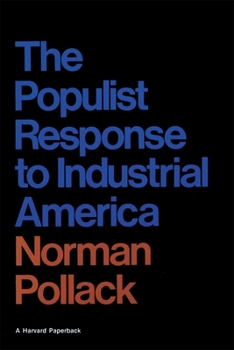
The Populist Response to Industrial America: Midwestern Populist Thought


Select Format
Select Condition 
Book Overview
Populism--progressive or retrogressive force? Posing this question, Norman Pollack draws on Populist manuscripts and newspapers, the best evidence for the movement's response to industrialism. In the words of farmers and workers, Populism springs to life, ceasing to be an abstraction. The author concludes that the movement, while primarily agrarian, had significant intellectual and labor support; accepting industrialization, it opposed capitalistic industrialism as alienating and degrading the individual. In this intellectual history--based on data most of which has been ignored--the author takes a first step toward a more comprehensive analysis of industrial America.
Format:Paperback
Language:English
ISBN:0674690516
ISBN13:9780674690516
Release Date:January 1976
Publisher:Harvard University Press
Length:176 Pages
Weight:0.47 lbs.
Dimensions:0.4" x 5.0" x 8.0"
Customer Reviews
2 ratings
A Brief History of the Populist Movement.
Published by Thriftbooks.com User , 17 years ago
In the Introduction of this book Norman Pollack offers this historical definition of Midwestern Populism- "While primarily an agrarian movement, it also contained significant support from industrial labor, social reformers, and intellectuals." "In a word, Populism regarded itself as a class movement, reasoning that farmers and workers were assuming the same material position in society. Thus it accepted industrialism but opposed the capitalistic form, seeking instead a more equitable distribution of wealth." From an editorial in the "Farmer's Alliance" was a quote that sounds relevant for today. "The theory of our government has been and is that the individual should possess the very greatest degree of liberty consistent not with the greatest good of the greatest number, but with the very least legal restraint compatible with law and order." The author explained the lack of cohesion between farmers and laborers. Populism should not be mistaken for a branch of Socialism. Socialism was partly responsible for the passing of the Populist movement. It's interesting that Populists generally held a dim view of both "free trade" and protectionism. The fusion of Populists with the Democrat party was detailed. It was the last gasp effort at survival of the movement. Davis Waite held that Populism alone " was based upon the principles of true democracy." "The Populist Response to Industrial America" is a brief, educational history of the Midwestern Populist movement and it's idealogy. There may be more detailed accounts in other books, but this book has more information than I expected from a small book.
A Revisionist Look at Populism
Published by Thriftbooks.com User , 18 years ago
In The Populist Response to Industrial America, Norman Pollack argues that Midwestern Populists were radical reformers who responded to industrialization in a progressive manner. Pollack's study is a revisionist response to previous Populist histories that portrayed the movement as regressive and opposed to industrialization. In presenting his case, Pollack relied on a number of primary sources, including manuscript collections of those involved in multiple levels of the movement and Populist newspapers. Such an approach seeks to provide a voice for the grassroots Populist. Populists opposed the accepted success myth, social Darwinism, and laissez-faire policies of the Gilded Age that placed a greater emphasis on property rights at the expense of human rights. Pollack argues that Populists wanted to redefine the relationship between man and industrialization so that the masses, and not the select elite, could benefit. Populists viewed industrialization as neutral, and that it only became a negative influence when capitalists exploited the technology at the cost of human dignity. The misuse of industrialization created a growing number of surplus workers, thus lowering the wages of the employed working class to a subsistence level while capitalists experienced economic gains. Populists wanted not socialism, but a redistribution of wealth that would preserve human dignity and industrial freedom. Agrarians, who are the main focus of the study, advocated state ownership of railroads and grain elevators, which would allow producers to realize a greater profit from the sale of their products. That agrarians wanted a greater profit, according to Pollack, separated the capitalistic Populists from the Socialists. In a radical effort to preserve their cause, Populists merged with the Democrats for the 1896 presidential election. Should Republican candidate William McKinley be elected to office, Populists felt, their cause for industrial freedom and wealth redistribution would come to an end. Uniting with the Democrats behind William Jennings Bryan, the Populists hoped to be able to use financial reform as a springboard for the passage of other Populist reforms. Ultimately, however, Bryan and the Populists were defeated, the latter being absorbed by the more conservative Democrats. Although writing with a bias that clearly sympathizes with the Populist cause, Pollack has created an interesting and engaging study that offers an alternative view of the Midwestern Populist movement.
Copyright © 2026 Thriftbooks.com Terms of Use
| Privacy Policy | Do Not
Sell/Share My Personal Information | Cookie Policy | Cookie Preferences | Accessibility Statement
ThriftBooks® and the ThriftBooks® logo are registered trademarks of Thrift Books Global, LLC
ThriftBooks® and the ThriftBooks® logo are registered trademarks of Thrift Books Global, LLC
