


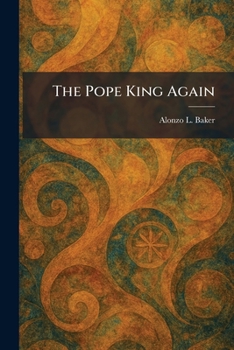
The Pope King Again

"The Pope King Again" examines one of the most significant diplomatic events of the early twentieth century: the signing of the Lateran Treaty in 1929. Through this historic agreement between the Holy See and the Italian government, the long-standing "Roman Question" was finally resolved, establishing the independent Vatican City State and restoring temporal sovereignty to the Pope. Alonzo L. Baker provides a detailed analysis of the political maneuvers and religious implications surrounding this restoration of the Papacy's status as a sovereign power.
The work delves into the complex relationship between Benito Mussolini's administration and the Catholic Church, exploring how the treaty altered the landscape of international relations and religious influence. Baker offers readers an insightful look at the transition from the Pope being a "prisoner of the Vatican" to once again being recognized as a king-like figure on the world stage. This book is a valuable resource for those interested in the history of the Papacy, the evolution of Church-State relations, and the geopolitical dynamics of interwar Europe. By focusing on the historical weight of these events, "The Pope King Again" remains a compelling study of power, diplomacy, and the enduring influence of the Vatican.
This work has been selected by scholars as being culturally important, and is part of the knowledge base of civilization as we know it. This work was reproduced from the original artifact, and remains as true to the original work as possible. Therefore, you may see the original copyright references, library stamps (as most of these works have been housed in our most important libraries around the world), and other notations in the work.
This work is in the public domain in the United States of America, and possibly other nations. Within the United States, you may freely copy and distribute this work, as no entity (individual or corporate) has a copyright on the body of the work.
As a reproduction of a historical artifact, this work may contain missing or blurred pages, poor pictures, errant marks, etc. Scholars believe, and we concur, that this work is important enough to be preserved, reproduced, and made generally available to the public. We appreciate your support of the preservation process, and thank you for being an important part of keeping this knowledge alive and relevant.
Customer Reviews
ThriftBooks ® and the ThriftBooks ® logo are registered trademarks of Thrift Books Global, LLC
