


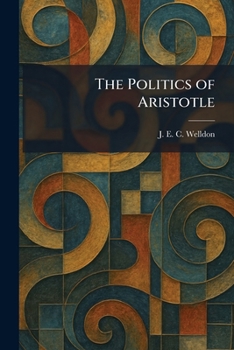
The Politics of Aristotle

Select Format
Select Condition 
Book Overview
"The Politics of Aristotle" is one of the most influential works of political philosophy in Western history. In this profound treatise, Aristotle examines the nature of the city-state (polis) and seeks to define the best possible form of government and the ideal way of life for its citizens. Exploring the fundamental relationship between the individual and the state, Aristotle analyzes various constitutions, the causes of revolution, and the essential components of a stable society.
Divided into eight books, the work delves into topics such as the household, property, and the classification of political systems including democracy, oligarchy, and monarchy. Aristotle's pragmatic approach contrasts with the idealism of his teacher, Plato, as he argues that the purpose of the state is to enable its citizens to achieve a life of virtue and happiness. He famously asserts that man is by nature a "political animal," suggesting that human fulfillment is only possible within a structured community.
This translation by J.E.C. Welldon provides a clear rendering of Aristotle's complex arguments. It remains an essential text for students of history, political science, and philosophy, offering timeless insights into the principles of justice, law, and the pursuit of the common good.
This work has been selected by scholars as being culturally important, and is part of the knowledge base of civilization as we know it. This work was reproduced from the original artifact, and remains as true to the original work as possible. Therefore, you may see the original copyright references, library stamps (as most of these works have been housed in our most important libraries around the world), and other notations in the work.
This work is in the public domain in the United States of America, and possibly other nations. Within the United States, you may freely copy and distribute this work, as no entity (individual or corporate) has a copyright on the body of the work.
As a reproduction of a historical artifact, this work may contain missing or blurred pages, poor pictures, errant marks, etc. Scholars believe, and we concur, that this work is important enough to be preserved, reproduced, and made generally available to the public. We appreciate your support of the preservation process, and thank you for being an important part of keeping this knowledge alive and relevant.
Customer Reviews
ThriftBooks ® and the ThriftBooks ® logo are registered trademarks of Thrift Books Global, LLC
