


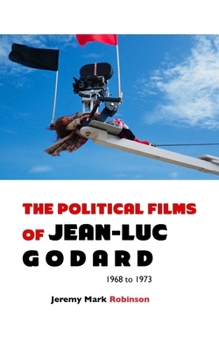
The Political Films of Jean-Luc Godard: Pocket Movie Guide

THE POLITICAL FILMS OF JEAN-LUC GODARD:
1968 TO 1973
POCKET MOVIE GUIDE
By Jeremy Mark Robinson
There's no one else quite like Jean-Luc Godard, one of the most significant and inspiring filmmakers of recent times. Where the flood of movies globally now runs into many thousands, Godard's works stand out as original, acerbic, romantic, ironic, controversial, humorous and explorative.
1967-1973 was the period when Jean-Luc Godard developed a series of political films, some of which were produced by the Dziga Vertov Group with Jean-Pierre Gorin and others (during this period, he was married to Anne Wiazemsky, who appears in several of the films). The political pictures of the period tend now to be seen as Dziga Vertov Group works, but actually the Dziga Vertov Group - and Gorin - only worked on a proportion of them. According to Gorin, the group only really coalesced around the time of Struggle In Italy (by which time Godard had already produced several political pieces. Also, towards the end, it was really only Godard and Gorin. The name Dziga Vertov was made up by Russian filmmaker Denis Kaufman. It means 'spinning top').
The political film period of 1968 to 1973 and the Dziga Vertov Group produced movies that included: Wind From the East, Lutte In Italia, British Sounds, A Film Like the Others, Until Victory (Palestine Will Win), Vladimir and Rosa, Pravda, Tout Va Bien and Letter To Jane. Some were unfinished, and some were not broadcast as planned, or released.
The Dziga Vertov Group and the 1968-1973 political films were shot on Eastmancolor 16mm, with apparently everything being decided by the group, and everyone being paid equally. The money came from TV channels in Europe, with Jean-Luc Godard typically being commissioned to direct a documentary about a political topic.
Fully illustrated. Bibliography, filmography, Godardisms and notes.
Customer Reviews
ThriftBooks ® and the ThriftBooks ® logo are registered trademarks of Thrift Books Global, LLC
