


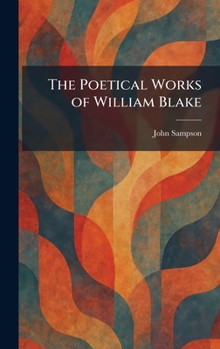
The Poetical Works of William Blake

"The Poetical Works of William Blake" offers a comprehensive collection of the profound and visionary output of one of the most influential figures in English literature. This volume encompasses the full breadth of Blake's poetic genius, from the lyrical simplicity of "Songs of Innocence and of Experience" to the complex, mythic structures of his later prophetic books. As a central figure of the Romantic Age, Blake's work is characterized by its intense mysticism, social critique, and a unique philosophical framework that challenged the rationalism of his era.
This authoritative compilation provides readers with an authentic rendering of Blake's verses, reflecting his unconventional spirit and revolutionary artistry. The collection highlights the poet's exploration of the human soul, the nature of divinity, and the struggle between creative freedom and societal constraint. Readers will encounter iconic poems such as "The Tyger," "The Lamb," and "London," alongside more expansive works that delve into his elaborate personal mythology. "The Poetical Works of William Blake" remains an essential resource for students, scholars, and lovers of poetry, capturing the enduring power of a creator who sought to see the world in a grain of sand and heaven in a wild flower.
This work has been selected by scholars as being culturally important, and is part of the knowledge base of civilization as we know it. This work was reproduced from the original artifact, and remains as true to the original work as possible. Therefore, you may see the original copyright references, library stamps (as most of these works have been housed in our most important libraries around the world), and other notations in the work.
This work is in the public domain in the United States of America, and possibly other nations. Within the United States, you may freely copy and distribute this work, as no entity (individual or corporate) has a copyright on the body of the work.
As a reproduction of a historical artifact, this work may contain missing or blurred pages, poor pictures, errant marks, etc. Scholars believe, and we concur, that this work is important enough to be preserved, reproduced, and made generally available to the public. We appreciate your support of the preservation process, and thank you for being an important part of keeping this knowledge alive and relevant.
Customer Reviews
ThriftBooks ® and the ThriftBooks ® logo are registered trademarks of Thrift Books Global, LLC
