


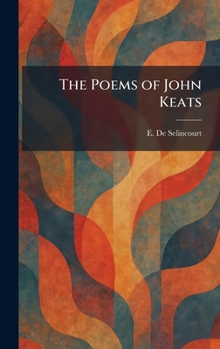
The Poems of John Keats

"The Poems of John Keats" presents the complete and breathtaking body of work by one of the most essential figures in the English Romantic movement. Although his career was tragically brief, Keats produced some of the most enduring and beautiful verses in the English language, characterized by their rich sensory imagery, emotional depth, and philosophical inquiry. This collection brings together his most celebrated masterpieces, allowing readers to trace the development of his unique poetic voice.
The volume includes his world-renowned odes, such as "Ode to a Nightingale" and "Ode on a Grecian Urn," alongside narrative poems like "The Eve of St. Agnes" and his ambitious epics like "Endymion" and "Hyperion." Keats's work explores the tension between the fleeting nature of life and the eternal beauty of art, a theme that remains profoundly relevant today. Known for his concept of "negative capability," Keats invites the reader into a world of mystery and imagination where beauty is truth. "The Poems of John Keats" is a cornerstone of classic literature, offering a definitive look at a poet whose mastery of language and sensitivity to the human condition have earned him a permanent place in the literary canon. It is an indispensable volume for any student of poetry or lover of the Romantic tradition.
This work has been selected by scholars as being culturally important, and is part of the knowledge base of civilization as we know it. This work was reproduced from the original artifact, and remains as true to the original work as possible. Therefore, you may see the original copyright references, library stamps (as most of these works have been housed in our most important libraries around the world), and other notations in the work.
This work is in the public domain in the United States of America, and possibly other nations. Within the United States, you may freely copy and distribute this work, as no entity (individual or corporate) has a copyright on the body of the work.
As a reproduction of a historical artifact, this work may contain missing or blurred pages, poor pictures, errant marks, etc. Scholars believe, and we concur, that this work is important enough to be preserved, reproduced, and made generally available to the public. We appreciate your support of the preservation process, and thank you for being an important part of keeping this knowledge alive and relevant.
Customer Reviews
ThriftBooks ® and the ThriftBooks ® logo are registered trademarks of Thrift Books Global, LLC
