


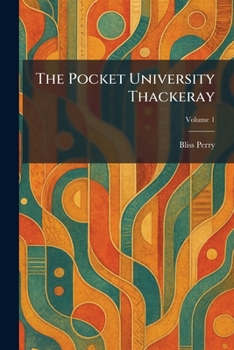
The Pocket University Thackeray

"The Pocket University Thackeray" is a curated collection of writings by the esteemed Victorian novelist and satirist William Makepeace Thackeray, compiled and introduced by the noted scholar Bliss Perry. This volume offers readers an essential gateway into the sharp wit and social commentary that defined Thackeray's literary career. Known primarily for his masterful exploration of the English class system and human vanity, Thackeray's works bridge the gap between humorous sketches and profound psychological realism.
Inside this collection, readers will find a selection of Thackeray's shorter works, essays, or excerpts that showcase his unique narrative voice and his ability to blend cynicism with a deep-seated humanity. From the biting irony of his character sketches to his astute observations on the hypocrisies of 19th-century society, the pieces included here reflect the breadth of his contribution to English letters. As part of a series designed to bring the classics to a wider audience, this volume highlights why Thackeray remains a central figure in the history of the British novel. Whether exploring his satirical takes on the "snobs" of his era or his more sentimental reflections, "The Pocket University Thackeray" serves as an enduring testament to the genius of one of the 19th century's most influential prose stylists.
This work has been selected by scholars as being culturally important, and is part of the knowledge base of civilization as we know it. This work was reproduced from the original artifact, and remains as true to the original work as possible. Therefore, you may see the original copyright references, library stamps (as most of these works have been housed in our most important libraries around the world), and other notations in the work.
This work is in the public domain in the United States of America, and possibly other nations. Within the United States, you may freely copy and distribute this work, as no entity (individual or corporate) has a copyright on the body of the work.
As a reproduction of a historical artifact, this work may contain missing or blurred pages, poor pictures, errant marks, etc. Scholars believe, and we concur, that this work is important enough to be preserved, reproduced, and made generally available to the public. We appreciate your support of the preservation process, and thank you for being an important part of keeping this knowledge alive and relevant.
Customer Reviews
ThriftBooks ® and the ThriftBooks ® logo are registered trademarks of Thrift Books Global, LLC
