


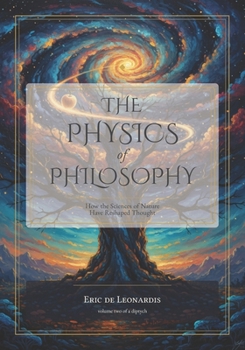
The Physics of Philosophy: How the Sciences of Nature Have Reshaped Thought

Philosophy is not embarrassed by physics. It is, however, periodically reshaped by it. When Newton wrote down the Principia, when Darwin published the Origin, when Clausius defined entropy, when Einstein redrew simultaneity, when Bohr and Heisenberg quarrelled with Einstein over the meaning of the quantum theory --- a piece of furniture in the philosopher's house moved. Sometimes a small piece. Sometimes the floor.
The Physics of Philosophy traces, theme by theme, the philosophical reshaping that the sciences of nature have provoked. Newton's mechanics gave Kant his categories; thermodynamics gave Bergson his quarrel with the clock; relativity gave Ortega's perspectivism a mathematical spine; quantum mechanics gave Bohr his complementarity and the idea that an observer cannot be safely edited out; cosmology forced "creation" out of theology and into the seminar room without resolving anything; information theory asked whether bits, not atoms, are the basement of the world.
The author writes as a Catholic intellectual who insists on staying objective: equidistant between scientific reason and the perspective of faith, never claiming that one is superior to the other. Believers and sceptics will both find themselves taken seriously. Three voices recur as quiet companions across the chapters: Fulton J. Sheen for the patient observation that empiricism is itself a metaphysical thesis; Thomas Aquinas for the analogy of being and the structure of secondary causes; and G. K. Chesterton for the paradox that clarifies. The didactic warmth owes a debt to Giovannino Guareschi at the level of style --- concrete images, plain speech --- not of setting. Lema tre's caution --- "do not confuse the Big Bang with the philosophical or theological notion of creation" --- is the spirit of the whole book.
This is the second of two twin volumes; the first, The Philosophy of Physics, walks the same road in the opposite direction --- from the philosophical assumptions hidden in physics back to physics. The two books echo one another; they can be read in either order.
Inside the bookThe Newtonian metaphysics and Kant's Copernican revolution.The Darwinian turn: from natural theology to the sciences of mind, with the design argument and its critics each given full voice.The arrow of time, from Clausius to the block universe and back.The end of physical absolutes (special and general relativity), with a careful note that what is relativised is the geometry of simultaneity, not morality.Quantum epistemology and what it means for "the observer."Complexity, mind, and the hard problem of consciousness.Cosmology and creation, treated with equidistance and Lema tre's warning kept in view.Information as ontology and the digital-physics conjecture.The ethics of the sciences and the limits of expert knowledge.For readers who want philosophy that has done its physics homework.
For students in either field who want to see how their two worlds touch.
For believers and sceptics alike who want a writer they can trust to be fair to both sides.
Customer Reviews
ThriftBooks ® and the ThriftBooks ® logo are registered trademarks of Thrift Books Global, LLC
