


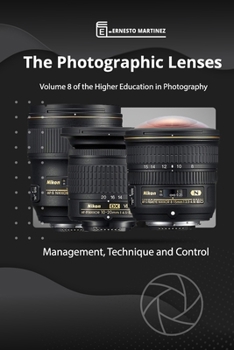
The photographic Lenses: Management, Technique and Control.
No Customer Reviews

A lens is not merely a set of optical elements enclosed in a metal and glass barrel. It is a promise. A way of seeing. A decision about what to include and what to leave out. Each lens is a distinct voice that translates light into language, transforming the world into an image.
This book is not a catalogue of specifications. It is a cartography of possibilities. Here you will not only learn what a 50 mm lens does or how a stabilized zoom operates. Here you will discover how narrative changes when you change lenses. How a wide-angle lens breathes spaciousness, how a telephoto lens whispers intimacy, how a macro lens reveals the invisible.
This book is for you, who wish to choose with awareness. You who know that every lens is a tool, but also a metaphor. You who understand that technique is not separate from emotion, and that every optical decision is also a poetic decision.
In this eighth volume of the "ADVANCED PHOTOGRAPHY TRAINING" series, we address the universe of camera lenses from a comprehensive perspective: technical, functional, narrative, and emotional. Throughout its chapters, the reader will find clear explanations, practical comparisons, and profound reflections on the following key elements:
1. Optical and Physical Construction
- Internal elements: spherical, aspherical, ED, UD lenses, anti-reflective coatings.
- Optical groups: arrangement and function of each lens element assembly.
- Body materials: metal, polycarbonate, weather and dust sealing.
- Mount: type, diameter, flange focal distance, compatibility.
2. Essential Technical Parameters
- Focal length: how it affects angle of view and spatial compression.
- Maximum aperture: f-number ratio and its impact on light, depth of field, and bokeh.
- Minimum focus distance and magnification: key factors in macro and detail photography.
- Optical stabilization: motion compensation in lenses with IS, VR, OSS, OIS.
3. Functional Typologies
- Standard lenses: versatile, natural, balanced.
- Wide-angle lenses: for landscape, architecture, interiors.
- Telephoto lenses: for portrait, wildlife, sports.
- Macro lenses: for extreme detail and 1:1 reproduction.
- Specialty lenses: fisheye, tilt-shift, pancake, cinema.
4. Ecosystems and Compatibility
- DSLR and mirrorless mounts: EF, F, E, RF, Z, X, L, MFT, GFX.
- Adapters: electronic, mechanical, with or without loss of features.
- Compatibility across APS-C and Full Frame bodies.
- Third-party lenses: Sigma, Tamron, Tokina, Samyang, Laowa, TTArtisan.
5. Optical Performance and Testing
- Sharpness: center vs. edges, effective resolution.
- Aberrations: chromatic, spherical, coma, distortion.
- Vignetting, flare, ghosting: how they affect the final image.
- MTF charts: interpretation and comparison between models.
6. Conscious Selection and Creative Use
- How to choose according to photographic genre, style, and workflow.
- Relationship between focal length and visual narrative.
- Practical exercises to explore each lens type.
7. Maintenance and Longevity
- Cleaning optical elements.
- Field protection: filters, lens hoods, cases.
- Diagnosing optical issues.
- Lifespan, repair, and resale value.
This book is designed for developing photographers, professionals seeking specialization, and visual creators who want to understand optical language in depth. Each chapter can be read independently or as part of a progressive journey. The intention is clear: that every photographer chooses their lenses with knowledge, emotion, and purpose.
Format:Paperback
Language:English
ISBN:B0BD24W4H8
ISBN13:9798351131566
Release Date:September 2022
Publisher:Independently Published
Length:200 Pages
Weight:0.60 lbs.
Dimensions:0.4" x 6.0" x 9.0"
Customer Reviews
0 rating
Copyright © 2026 Thriftbooks.com
Terms of Use | Privacy Policy | Do Not Sell/Share My Personal Information | Cookie Notice | Cookie Preferences | Accessibility Statement
ThriftBooks ® and the ThriftBooks ® logo are registered trademarks of Thrift Books Global, LLC
ThriftBooks ® and the ThriftBooks ® logo are registered trademarks of Thrift Books Global, LLC
