


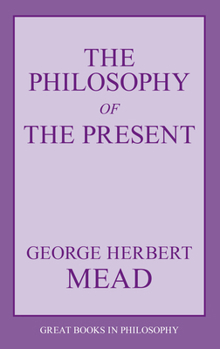
The Philosophy of the Present

Select Format
Select Condition 
Book Overview
George Herbert Mead (1863-1931) had a powerful influence on the development of American pragmatism in the twentieth century. He also had a strong impact on the social sciences. This classic book represents Mead's philosophy of experience, so central to his outlook.The present as unique experience is the focus of this deep analysis of the basic structure of temporality and consciousness. Mead emphasizes the novel character of both the present and the past. Though science is predicated on the assumption that the present is predictable based on a thorough knowledge of the past, the experience of the present, says Mead, is an utterly unique moment comparable to no other, and when it is past the novel character of that unique experience is irrevocable.The emergence of novelty within the perceived rational order of reality is the crux of the problem that Mead explores. The present, in his words, is "the emergent event . . . something which is more than the processes that have led up to it and which by its change, continuance, or disappearance, adds to later passages a content they would not otherwise have possessed." The present as "the seat of reality" heavily conditions our retrospective view of the past as much as it helps to shape the future. The novelty of every present experience causes us to reconstruct our preceding experiences to make sense of the past, which is naturally assumed to be the main cause of what we presently experience. Our perspective on reality is thus relative to the conditioning of each new event and it changes continuously as the effects of the present shift our view of the past and future.This emphasis on the integrative, holistic nature of reality, in which everything past, present, and future is a condition of everything else, makes Mead's philosophy highly relevant to today's scientific picture of a quantum universe, where chance and probability play a role in the emergence of reality. Also of great interest is the way in which he extends his basic analysis of temporal-spatial reality to the emergence of mind and consciousness as a natural development of the evolutionary process.This stimulating and provocative work attests to John Dewey's praise of Mead as "the most original mind in philosophy in America" of his generation.
Format:Paperback
Language:English
ISBN:1573929484
ISBN13:9781573929486
Release Date:January 2002
Publisher:Prometheus Books
Length:202 Pages
Weight:0.54 lbs.
Dimensions:0.5" x 5.4" x 8.4"
Customer Reviews
1 rating
A Great Book Indeed
Published by Thriftbooks.com User , 19 years ago
Mead is one of the key American pragmatists, and this book is his most important philosophical essay. The subject is primarily metaphysics: a relativist theory of time and space and the objective character of perspectives. So the book is for the most part quite abstract and therefore difficult, but Mead is thorough and repeats his points, so with a little patience a nonphilosopher can follow his reasoning. Mead's more familiar "sociology" about the social self and the collective other are discussed but not extensively.
Copyright © 2026 Thriftbooks.com
Terms of Use | Privacy Policy | Do Not Sell/Share My Personal Information | Cookie Notice | Cookie Preferences | Accessibility Statement
ThriftBooks ® and the ThriftBooks ® logo are registered trademarks of Thrift Books Global, LLC
ThriftBooks ® and the ThriftBooks ® logo are registered trademarks of Thrift Books Global, LLC
