


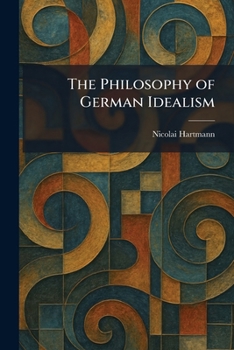
The Philosophy of German Idealism

"The Philosophy of German Idealism" provides a comprehensive and rigorous exploration of one of the most significant eras in Western thought. Authored by the renowned philosopher Nicolai Hartmann, this work examines the evolution of idealistic systems from the foundational critiques of Immanuel Kant to the absolute idealism of G.W.F. Hegel. Hartmann meticulously dissects the shifting paradigms of subjectivity, reason, and the absolute, tracing how thinkers like J.G. Fichte and Friedrich Schelling reshaped the landscape of metaphysics and epistemology.
The book serves as an essential guide for understanding the internal logic and historical trajectory of the German tradition, offering deep insights into the relationship between the mind and the world. Hartmann's clear and systematic approach makes this a foundational text for scholars and students of modern philosophy, shedding light on the complex debates that defined nineteenth-century intellectual life. By engaging with the core arguments of each major figure, the work highlights the enduring relevance of German idealism in contemporary philosophical discourse.
This work has been selected by scholars as being culturally important, and is part of the knowledge base of civilization as we know it. This work was reproduced from the original artifact, and remains as true to the original work as possible. Therefore, you may see the original copyright references, library stamps (as most of these works have been housed in our most important libraries around the world), and other notations in the work.
This work is in the public domain in the United States of America, and possibly other nations. Within the United States, you may freely copy and distribute this work, as no entity (individual or corporate) has a copyright on the body of the work.
As a reproduction of a historical artifact, this work may contain missing or blurred pages, poor pictures, errant marks, etc. Scholars believe, and we concur, that this work is important enough to be preserved, reproduced, and made generally available to the public. We appreciate your support of the preservation process, and thank you for being an important part of keeping this knowledge alive and relevant.
Related Subjects
PhilosophyCustomer Reviews
ThriftBooks ® and the ThriftBooks ® logo are registered trademarks of Thrift Books Global, LLC
