


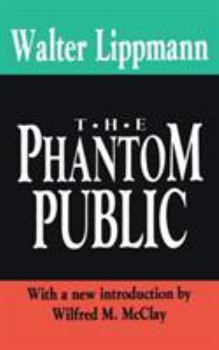
The Phantom Public


Select Format
Select Condition 
Book Overview
In an era disgusted with politicians and the various instruments of "direct democracy," Walter Lippmann's The Phantom Public remains as relevant as ever
Format:Paperback
Language:English
ISBN:1560006773
ISBN13:9781560006770
Release Date:January 1993
Publisher:Taylor & Francis Group
Length:244 Pages
Weight:0.59 lbs.
Dimensions:0.7" x 5.1" x 7.3"
Customer Reviews
1 rating
Problems not intractable
Published by Thriftbooks.com User , 16 years ago
Lippmann is usually taken to be a pessimist about democracy. Those who see him this way (and perhaps that would include Lippman himself) fail to consider that Lippmann's diagnosis of the failed citizen and his convincing argument that the citizen simply lacks the inclination and capacity for genuine democratic participation is most convincing only if people consider big, centralized and increasingly intrusive government as an inevitability. It isn't. Further, those who consider it an inevitability generally argue that it is so because it is a necessity. Society, they argue, has become so complex and intertwined and thus delicate that decision making must by necessity be in the hands of those who can recognize and handle its complexity. In other words, experts. This is the view that justifies dictatorships of the proletariat, a talented tenth and bureaucracy. Further, starting from the pretense that people are bad decision makers, those who actually govern the society need to be isolated from the democratic process. If society is to be managed, it must be managed without having to answer to all the fools clamouring for the irrational through their legislative representatives. The idea things are so complex that ordinary men can't really govern reminds me of the Hobbesian notion that people are inherently corrupt and driven to abuse power for their own unseemly purposes and thus we need to concentrate power in the hands of a monarch. In other words: all people are corrupt, so let's give total power to a person. The real folly is not that the ordinary citizen is too ill informed to manage society; the real folly is that people are capable of being well informed enough to manage much more than their own lives. Just as the average citizen can't really vote rationally on complex matters involving untold numbers of people and circumstances, so the planner cannot really understand, much less actually know, all of the information needed for a truly informed decision. In other words, the more complex a society becomes, the more simple and limited its government must become. People are not rendered incapable of governing; they just need to have their input limited to their immediate set of circumstances. Here, their decisions won't always yield the results anticipated, but they are certainly in a better position to know why. Thus, the idea that Lippmann's view of the democratic citizen to effectively manage the United States is depressing only if you think that it can't manage itself. It can. It's called a free market. As for the people's voice in government, they remain perfectly capable of directing state and local governments towards desirable ends. What Lippmann really proves it that the anti-Federalists were right. Local government governs best. "Average" people can govern the children's schools, the local police - but, the real point evaded by both Lippmann and his critics is that people can govern their own lives quiet w
Copyright © 2026 Thriftbooks.com
Terms of Use | Privacy Policy | Do Not Sell/Share My Personal Information | Cookie Policy | Cookie Preferences | Accessibility Statement
ThriftBooks ® and the ThriftBooks ® logo are registered trademarks of Thrift Books Global, LLC
ThriftBooks ® and the ThriftBooks ® logo are registered trademarks of Thrift Books Global, LLC
