


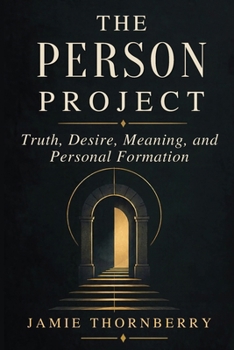
The Person Project: Truth, Desire, Meaning, and Personal Formation

Truth, Desire, Meaning, and Personal Formation
You may understand yourself better than most people.
You know your patterns. You can name your emotions. You understand your history. You may even know exactly where some of your fears, habits, and desires came from.
So why do you keep repeating what you already know you want to change?
Why do some desires become harder to resist the more you understand them?
And why can greater self-awareness sometimes leave you more confused rather than more free?
Because self-knowledge is not the same as wisdom-and explaining yourself is not the same as forming yourself.
Modern culture has taught us to look inward for answers. We have learned to identify our feelings, trace our wounds, examine our childhoods, and construct narratives about who we are.
These tools can be useful. But they are not enough.
We have confused naming a feeling with understanding it. We have confused explaining a desire with justifying it. And we have allowed our past to become more than an explanation of who we are-it has become a verdict about who we can become.
In The Person Project, Jamie Thornberry examines the deeper forces that shape a human life: truth, desire, meaning, conscience, and formation.
Drawing from philosophy, theology, cultural analysis, and a careful examination of human experience, Thornberry challenges the assumption that freedom comes simply from expressing yourself or understanding yourself.
Instead, he asks a more fundamental question:
What kind of person are you becoming-and by what standard should that becoming be judged?
Inside, you will discover:
- Why self-awareness alone cannot produce freedom-and why a person can become highly conscious of his patterns without becoming capable of changing them.
- Why your feelings are real but not necessarily authoritative, and how confusing emotional experience with moral truth can distort your understanding of yourself.
- How desire forms character, and how desires that initially feel like freedom can gradually become masters.
- Why your past can explain you without defining you, and how to distinguish genuine understanding from psychological determinism.
- Why meaning cannot simply be invented, and why a coherent life requires more than a personally satisfying narrative.
- How conscience, desire, truth, and action work together in the formation of a human being.
- Why personal formation is ultimately a moral and philosophical question, not merely a psychological one.
You are more than your thoughts.
More than your feelings.
More than your wounds.
More than your history.
More than your social roles.
You are a person-and a person is always being formed.
The question is not whether you are becoming something.
You are.
The question is whether you understand what is forming you, whether your desires are ordered toward what is genuinely good, and whether the person you are becoming is capable of living in truth.
The Person Project: Truth, Desire, Meaning, and Personal Formation is not another guide to self-optimization, emotional management, or endless introspection.
It is an invitation to recover a deeper vision of the human person-and to begin the difficult, necessary work of becoming whole.
Because knowing yourself is only the beginning.
The real question is: What are you becoming?
Customer Reviews
ThriftBooks ® and the ThriftBooks ® logo are registered trademarks of Thrift Books Global, LLC
