


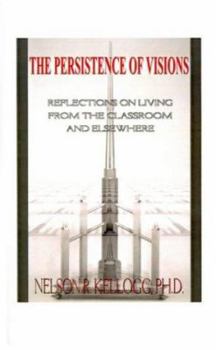
The Persistence of Visions: Reflections on Living from the Classroom and Elsewhere


'Where there is no vision, the people perish ...' (Proverbs 29:18) These words, written perhaps three thousand years ago, are more vibrantly important today than ever. We are certainly 'living in... This description may be from another edition of this product.
Format:Paperback
Language:English
ISBN:1585005002
ISBN13:9781585005000
Release Date:January 1999
Publisher:1st Book Library
Length:404 Pages
Weight:0.95 lbs.
Dimensions:1.0" x 5.4" x 7.9"
Related Subjects
PhilosophyCustomer Reviews
5 ratings
The Persistence of Inquiry
Published by Thriftbooks.com User , 22 years ago
We are all philosophers, consciously or not. And we all have visions, which we either nurture or let wither. Dr. Kellogg has written here a deeply honest and authentic account of his own search for deeper meaning than the practical, for a broader canvas than the personal. I read this fascinating, broadly informative, wide-ranging work with recognition of a fellow seeker. The gratitude he has integrated into his own habits of reflection was also mirrored in my finding of another visionary who values living for understanding as much as for effect. I share Dr. Nelson's chosen passion for science and technology studies, and his belief in the critical importance of understanding the meaning of accelerating technologies, of gaining physical wisdom. At the same time, he talks intimately of the need for understanding and making peace with one's interior states, of gaining what my favorite transhumanist mystic Tielhard de Chardin (The Phenomenon of Man, 1955) would call "psychical wisdom," both of oneself and ones interaction with the wider world. I don't know if Dr. Nelson has read Tielhard, but I know he would recognize himself in that classic, as I have recognized myself in this wonderful work. Thanks for living your life as you have, for persisting in the chain of inquiry, and for nurturing our collective vision.
Imagination drives the Intellect
Published by Thriftbooks.com User , 26 years ago
I live in Ireland and I picked this book up on a recent visit to Boston, Mass. This book is very wide-ranging yet successful in connecting its components. I liked the following points: 1 The necessity for Gratitude not only in the character formation of children but also in uplifting the adult intellect beyond the mundane. The comments on Henry Adams and the Cathedral of Chartres evolving from the intellects formed in the Middle Ages are inspiring. Books relevant to gratitude in children include James Stenson's Lifeline ISBN 0-933932-97-9; 2 The book has an interesting aside on Pierre Duhem whose roles as a first rate theoretical physicist and as a researcher of the origin (in the Middle Ages) of modern science are only now being recognised. This book is an introduction to The Limits of a Limitless Science by Stanley L Jaki ISBN 188292646-3 or www.isi.org; 3 This book highlights that we need to cultivate the virtues within each one of us in order to have order, reason and possible happiness in our lives. The 4 cardinal virtues got a positive mention out of the mouth of Marcus Aurelius's son in the film The Gladiator. This book shows that we are to seek Wisdom outside of ourselves. Like truth, it is out there to be found.
St. Augustine in the 21st Century
Published by Thriftbooks.com User , 26 years ago
This book elevates teaching in American schools and colleges to a sacred art, by example as much as by the richness of its requirement that the reader sit up, respect himself or herself, and pay attention--because this MATTERS. To be Dr. Kellogg's student must be a rare and precious pleasure. No light reading, but in angelically clear prose, this is a personal and deeply contemplative suite of essays spawned by a lifetime of engaged teaching in science classrooms. "The Confessions of St. Augustine" and "Surely You're Joking, Mr. Feynmann!" need a third to form a braid, and this book is it. Professor Kellogg, a scientist and philosopher as well as an outstanding and decorated teacher whose teaching range spans nearly every conceivable educational venue, is searingly honest and relentlessly probing. Like St. Augustine, this career teacher is a practical visionary, at times monastically lonely and at others ecstatically devoted, both nourished by aspiration and pressed by solitude into the most difficult questions. Also like St. Augustine, Kellogg finds eternal stuff in the present moment: even when he recalls another thinker, he develops and applies that other mind as part of his own universal quest, personally felt and embodied in his own experience. What could he mean when he says, "That's so far off, it's not even wrong?" His reader, encountering that quoted phrase, sees through to its origin, and on to its applications tomorrow, thanks to Professor Kellogg's consistently elegant prose and intricate, heartfelt argument. Not since the works of John Dewey has it been so clear that the teaching of any discipline elevates each human who will engage that enterprise honestly. This book, an endorsement of education in and for a democracy of vital souls, belongs on a shelf among the most elegant, heartfelt, and persuasive defenses of the union of intellect, spirit, and educational institutions, leaning up respectfully against _The Confessions_, and giving us all hope for the future as we take up and read.
Stretching to Home
Published by Thriftbooks.com User , 26 years ago
I watched Buzz Kellogg write this book-that is, I knew him and regularly talked with him during its writing. It began as a commentary on his experiences and observations from his tenure as a classroom professor. It quickly grew far beyond those walls. The book is an intriguing process of stretching the readers powers of observation far beyond (and beneath) the levels and spaces we daily record. I am not a teacher and it this general aspect of Kellogg's book I found fascinating. This book challenges the basic assumptions and underpinnings of our laxidasical phlsophical approach to life. What really counts? Why? Where dose it come form? How does it accumulate and evaporate? What creates purpose and meaning? How? Why? How is it that humans relate and understand?Kellogg gently leads the reader through the transcendant and almost scared which surrounds and infuses our daily existence.What do I like most about the book? Yes, it is being stretched to consider facets, spectrums, and hues I usually don't take time to notice. Yes, it is gaining a clearer perspective on questions like "What's the point?" But it is also the way Kellogg writes. It is vivid, personal, conversational, and flows with the energy and effervescence that characterizes Buzz's oral conversation. The writing is alive. He was excited and energized to write it and that joy shows in every page.
Welcome to the real world
Published by Thriftbooks.com User , 26 years ago
There is a moment in our family history that we refer to with a laugh whenever we seek some grounding in today's go-go, hyperspeed, so-materialistic world. A casual acquaintance, a woman steeped in show business, dismissed one of my wife's preoccupations with the silly line, "The real world is not just sitting around reading books, Sheila!" In his elegant and thought-provoking new work, "The Persistence of Visions," Nelson "Buzz" Kellogg helps us to overcome some of the anti-intellectual pressures of popular culture and to see clearly how age-old human searches for spirituality through storytelling can guide us toward a future we can mold -- at least in part -- for ourselves. As a professor at Sonoma State University in California, Kellogg writes that he has often "heard of formal education referred to as the artificial antecedent to real life, or the real world." In fact, as Kellogg makes clear with examples he culls from conversations with students in his classrooms, there is no more valuable a role for us than taking advantage of the opportunities we can enjoy to try to figure out who we are and what we're doing here. In an era when so many people, particularly during this economic boom in America, seem to find reality sipping a four dollar cup of coffee while studying stock quotes, "The Persistence of Visions" offers a guide back to the reality we can seek through some self examination. And for me, there is an immediate practical application to the musings and lessons in Professor Kellogg's imaginative writings: his thoughts and interpretations, the quotes he brings to the pages from past philosophers, and his arguments for envisioning an exciting, productive future, all provide valuable cocktail party ammunition against the next mundane post-literate suggestion that the real world is not just sitting around and reading books. In fact, "The Persistence of Visions" ought to be on the must-read list of those seeking some help combating the assault of superficiality we face daily from the mind-numbing entertainment factories of the pop world. It is a reminder that one of the true values we can reap from today's wealth is the time to study.
Copyright © 2026 Thriftbooks.com
Terms of Use | Privacy Policy | Do Not Sell/Share My Personal Information | Cookie Notice | Cookie Preferences | Accessibility Statement
ThriftBooks ® and the ThriftBooks ® logo are registered trademarks of Thrift Books Global, LLC
ThriftBooks ® and the ThriftBooks ® logo are registered trademarks of Thrift Books Global, LLC
