


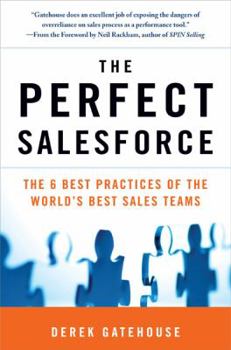
The Perfect SalesForce: The 6 Best Practices of the World's Best Sales Teams

How any company can build an incredibly effective salesforce by learning from the best in the world Despite billions spent every year on personality profiling, sales training, motivational experts, coaches, and incentives, there's never been a proven formula for building a salesforce of top performers. Finding such a "holy grail" of sales has been Derek Gatehouse's obsession for decades. To identify what makes a top-producing salesperson-the kind who sells four times more than everyone else-and why some sales teams have a high percentage of top producers, he interviewed more than two thousand executives in many different industries. His findings challenge the conventional wisdom about hiring, training, managing, and rewarding a sales team. Gatehouse has tested virtually every personality assessment tool, sales process, training methodology, and management system available, only to conclude that the vast majority of those systems don't raise performance in a lasting way. Instead, the world's greatest sales teams share six simple but critical practices.
Format:Hardcover
Language:English
ISBN:159184178X
ISBN13:9781591841784
Release Date:November 2007
Publisher:Portfolio Hardcover
Length:288 Pages
Weight:1.20 lbs.
Dimensions:9.3" x 1.1" x 6.2"
Age Range:18 years and up
Grade Range:Grade 12 and higher
Customer Reviews
5 ratings
So Far So Good
Published by Thriftbooks.com User , 16 years ago
I am most of the way through first reading. It is an easy read and very informative. Will need to read a couple more times to fully digest and put in practice. I believe it will be very useful for our company.
A great guide to jumpstart your sales team
Published by Thriftbooks.com User , 17 years ago
Few people would argue that one of the toughest job in nearly every organization resides within the sales department. However, there is a wide performance variance that separates the slugs and superstars along the sales spectrum. When you consider that a top-sales producer may generate four times the gross revenue of their closest colleague, it's easy to see why billions are spent each year trying to find the secret necessary to duplicate that success. Author Derek Gatehouse took up that challenge and interviewed more than 2,000 executives to uncover the formula for extreme sales success. In his resulting book titled The Perfect Sales Force, Gatehouse offers six critical practices that the best sales teams have in common. These best-in-class practices alone are worth much more than the price of the book. But Gatehouse expertly enlarges them to help sales managers identify and assess those intangible attributes that drive successful sales, which is why Soundview recommends this read. If you need to jumpstart your sales team, you need to get this book.
You are better off emphasizing hiring the most talented rather than trying to improve the mediocre
Published by Thriftbooks.com User , 17 years ago
Derek Gatehouse has spent more than 30 years working at every level of sales in many industries. This book distills what he has learned about what works in sales and what he teaches to his clients as CEO of Vendis, Inc. The foundational idea of the book is that there is no secret to sales that you can give to people without sales talent that will turn them into top performers. Instead, he argues, you need to understand the kind of talents your company needs in its salespeople and hire the most talented people of that type that you can. He urges you to study your most successful salespeople and guides you in what to look for in their work. By learning what they do right you can hire more people with the same abilities. The key is to be more dispassionate and not hire someone because they seem good to you or that you like them. You need performers. So, learn what makes such people tick and hire them. The book has 9 chapters and an appendix with a 50-page case study of a real company that illustrates the entire process he lays out in this book. And a good index. The nine chapters cover: 1) The Perfect Salesforce - he makes his case for native talent over the notion of teaching sales. 2) The 6 Best Practices - The 10 Selling Talents, Sorting Stages for Talent, Talent-Based Hiring, Pay and Quota, Sales Behavior Training, Result-Based Management. 3) The 10 Selling Talents 4) Sorting Sales Stages for Talent 5) The Talent Based Hiring Process 6) The Pay Plan and Quota 7) Sales Behavior Training 8) Result-Based Management 9) Growing `The Perfect Salesforce' While the first 3 of the best practices are likely to be the most different for you (at least they were for me), the author lays out his principles very well. He also provides online forms and even a bookmark you can print out to help you. I think what Gatehouse says about sales makes sense and much of it agrees with my personal experience. There are naturally talented salespeople, and there are different sales requirements at different companies, for different sales assignments, and the way you set up their pay and quote matters and great deal. And I like his emphasis on sales training having something to offer in adding refinements to talent and management by emphasizing the positive. His saying that under performing salespeople are miscast is spot on. What others call firing he calls releasing and I like that wording a lot. I did the same thing when I found people who just couldn't get a job done. My emphasis was that they deserved to be successful, but the job they had was not going to help them be successful. A thoughtful and helpful book. Reviewed by Craig Matteson, Ann Arbor, MI
An authoritative guide on how to build a great salesforce
Published by Thriftbooks.com User , 17 years ago
You could probably run a small country with the money sales organizations spend on standardized training. Unfortunately, most of it goes right down the drain, according to sales guru Derek Gatehouse, who says many of today's highly touted sales methods don't make much difference. To him, they are all so much voodoo. Gatehouse believes that instead of wasting money on ordinary training and cookie-cutter processes, companies should focus on hiring only people with "naturally born" sales talent and enlisting only the very best sales managers to supervise them. Then, they should carefully structure their pay programs to give salespeople true incentives. Gatehouse developed his robust sales acumen while toiling for three decades in America's toughest sales trenches. Given this lucid manual, getAbstract finds that he has a lot to teach most companies about organizing and running topflight sales teams.
How to create and then maintain an "autonomous growth machine"
Published by Thriftbooks.com User , 18 years ago
Ignore this book's title. Surely Derek Gatehouse knows that there is no such entity as a "perfect sales force" but indeed there is much of great value to be learned from what the book's subtitle suggests: "the best practices of the world's best sales teams." However, questions immediately arise: Which are they? Who selected them? According to which criteria? How recent was the information when the selections were made? (Note: Most of the companies that Peters and Waterman praise in In Search of Excellence no longer meet the criteria by which they were selected and several of them have since been acquired by another company.) Gatehouse shares the results of the Gallup organization's 30-year study of top performance, which includes more than 3,000,000 people thus far. He asserts that people rather than processes process sell, and, that those who are "natural born" sales people will "sell circles around all the rest." How to develop such a sales force? "The only feasible growth system for a sales force, and the only way to build a sales force of top performers, is to learn the language of selling talents. This will let you cast the exact right talents into each stage of your particular sales type, and then gain an understanding of what specific conditions generate autonomous top performance from these gifted sellers." That in the proverbial "nutshell" is what Gatehouse's book is all about: explaining "the formula for a top-producing sales force, one that is made up primarily of those salespeople that sell four times more than all others." This formula takes into full account three separate but interdependent components: "natural-born" sales aptitude, performance enhancement training, and the environment (i.e. "external conditions")in which people sell. With regard to how Gatehouse organizes his material, he introduces the six best practices of "the perfect salesforce" in Chapter 2 and then devotes a separate chapter to each. For example, #1 consists of ten "selling talents" that Gatehouse examines with rigor and eloquence and #6 consists of best practices in results-based management. In the final chapter, he explains the need for a Perfect SalesForce committee that has only one purpose: to ensure that initiatives "stay on track" as the six best practices are adopted during what amounts to a two-phase process: determination of the changes that need to be made and then the on-going, daily operations. "This latter phase is where companies go off track; everyone is too close to the daily grind to step back and see things objectively. It is here that your committee best serves." Gatehouse then offers a detailed case history of an actual company, Dilan Ink, with which he was closely associated. He explains a four-stage process that begins with an assessment of the current situation and concludes with training. For whom will this book be most valuable? Certainly anyone who serves on a "Perfect SalesForce committee" whose membership should include a
Copyright © 2026 Thriftbooks.com Terms of Use
| Privacy Policy | Do Not
Sell/Share My Personal Information | Cookie Policy | Cookie Preferences | Accessibility Statement
ThriftBooks® and the ThriftBooks® logo are registered trademarks of Thrift Books Global, LLC
ThriftBooks® and the ThriftBooks® logo are registered trademarks of Thrift Books Global, LLC
