


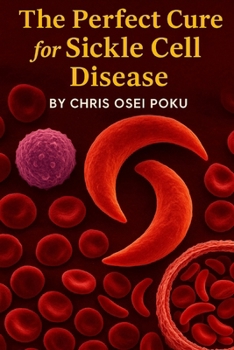
The Perfect Cure for Sickle Cell Disease
No Customer Reviews

In the Late 2040s
I didn't sleep the night the cure activated. Couldn't. Not because of anxiety, not even fear-but something deeper. Something I didn't yet have a name for.
I was standing inside the GenCore Facility's Observation Dome-Level 9, Sector L3-when the neural interface gave its final confirmation.
"CRISPR-Quantum Correction complete. HbS reverted to wild-type. Zero off-targets. End of transmission."
My breath stopped. Just for a second.
We had done it.
I had done it.
Sickle cell disease-this ancient torment encoded into the blood of millions-was gone. In her. The first patient. Patient Zero. A 17-year-old girl who had been in and out of pain crises since she was six months old. Her chart read like a battlefield: ischemic stroke at 12, avascular necrosis at 15, chronic anemia every day in between. Morphine, hydroxyurea, blood exchanges. Nothing ever permanent.
Until tonight.
She was asleep in Recovery Bay 4. A mild fever, expected. Her neural vitals were stable. Bone marrow activity had already normalized within the hour. Hemoglobin electrophoresis was reading 98% HbA. Zero HbS. No HbF manipulation, no grafts, no transplant, no immune suppression.
Just one injection.
Delivered via in vivo nanoinfusion.
Powered by CRISPR 10.7.
Guided by AI-diagnostics.
Corrected forever.
I stood over her bed for a long time, watching the nanobot activity decline as her cells stabilized. The artificial intelligence whispered across my retina through my ocular overlay-confirming that her hematopoietic stem cells were already self-replicating corrected versions. Her progeny, too, would carry the fix. The beta-globin mutation was not just cured.
It was deleted.
I remember gripping the bedside rail. My hands were trembling. I thought of all the patients over the years. The funerals. The fear in their eyes. The young girl who died in my second year of clinical rotations after an acute chest syndrome that turned septic. She was only five. Her name was Eleni. I had promised her mother I'd never stop trying. And now, in this room... I had finally kept my word.
This wasn't a treatment.
This was a reversal of destiny.
Years ago, people said curing sickle cell disease was too complex. That the genome was too delicate. That gene editing was too risky. I heard them. I read their papers. I even respected their caution. But deep down, I knew: it wasn't that we couldn't. It was that we hadn't yet dared to try everything at once.
I didn't build a cure. I engineered a system of converging breakthroughs-CRISPR 10.7 with zero off-target risk. Real-time, AI-augmented molecular surveillance. Nanobot delivery platforms smaller than mitochondria. Epigenetic firewalls. Quantum-level protein reprogrammers. And most importantly, exosome-guided payloads that learned from the patient's own cells how to infiltrate and correct without triggering a single immune alarm.
The Perfect Cure.
It wasn't just about replacing sickle hemoglobin. It was about designing a future in which sickle cell disease had no molecular foothold left to stand on.
The global registry updated her status six hours later.
Condition: Cured.
Prognosis: Normal lifespan. No recurrence. No complications.
DNA footprint: Corrected. Heritable.
I collapsed into the observation chair as dawn crawled across the sky. The bots dimmed the lights. The neural link shut down.
For the first time in history, someone with sickle cell disease was no longer sick. Not managed. Not in remission.
Cured.
And this was only the beginning.
I didn't sleep the night the cure activated. Couldn't. Not because of anxiety, not even fear-but something deeper. Something I didn't yet have a name for.
I was standing inside the GenCore Facility's Observation Dome-Level 9, Sector L3-when the neural interface gave its final confirmation.
"CRISPR-Quantum Correction complete. HbS reverted to wild-type. Zero off-targets. End of transmission."
My breath stopped. Just for a second.
We had done it.
I had done it.
Sickle cell disease-this ancient torment encoded into the blood of millions-was gone. In her. The first patient. Patient Zero. A 17-year-old girl who had been in and out of pain crises since she was six months old. Her chart read like a battlefield: ischemic stroke at 12, avascular necrosis at 15, chronic anemia every day in between. Morphine, hydroxyurea, blood exchanges. Nothing ever permanent.
Until tonight.
She was asleep in Recovery Bay 4. A mild fever, expected. Her neural vitals were stable. Bone marrow activity had already normalized within the hour. Hemoglobin electrophoresis was reading 98% HbA. Zero HbS. No HbF manipulation, no grafts, no transplant, no immune suppression.
Just one injection.
Delivered via in vivo nanoinfusion.
Powered by CRISPR 10.7.
Guided by AI-diagnostics.
Corrected forever.
I stood over her bed for a long time, watching the nanobot activity decline as her cells stabilized. The artificial intelligence whispered across my retina through my ocular overlay-confirming that her hematopoietic stem cells were already self-replicating corrected versions. Her progeny, too, would carry the fix. The beta-globin mutation was not just cured.
It was deleted.
I remember gripping the bedside rail. My hands were trembling. I thought of all the patients over the years. The funerals. The fear in their eyes. The young girl who died in my second year of clinical rotations after an acute chest syndrome that turned septic. She was only five. Her name was Eleni. I had promised her mother I'd never stop trying. And now, in this room... I had finally kept my word.
This wasn't a treatment.
This was a reversal of destiny.
Years ago, people said curing sickle cell disease was too complex. That the genome was too delicate. That gene editing was too risky. I heard them. I read their papers. I even respected their caution. But deep down, I knew: it wasn't that we couldn't. It was that we hadn't yet dared to try everything at once.
I didn't build a cure. I engineered a system of converging breakthroughs-CRISPR 10.7 with zero off-target risk. Real-time, AI-augmented molecular surveillance. Nanobot delivery platforms smaller than mitochondria. Epigenetic firewalls. Quantum-level protein reprogrammers. And most importantly, exosome-guided payloads that learned from the patient's own cells how to infiltrate and correct without triggering a single immune alarm.
The Perfect Cure.
It wasn't just about replacing sickle hemoglobin. It was about designing a future in which sickle cell disease had no molecular foothold left to stand on.
The global registry updated her status six hours later.
Condition: Cured.
Prognosis: Normal lifespan. No recurrence. No complications.
DNA footprint: Corrected. Heritable.
I collapsed into the observation chair as dawn crawled across the sky. The bots dimmed the lights. The neural link shut down.
For the first time in history, someone with sickle cell disease was no longer sick. Not managed. Not in remission.
Cured.
And this was only the beginning.
Format:Paperback
Language:English
ISBN:B0FHF9XB8P
ISBN13:9798292185871
Release Date:July 2025
Publisher:Independently Published
Length:40 Pages
Weight:0.15 lbs.
Dimensions:0.1" x 6.0" x 9.0"
Customer Reviews
0 rating
Copyright © 2026 Thriftbooks.com Terms of Use
| Privacy Policy | Do Not
Sell/Share My Personal Information | Cookie Policy | Cookie Preferences | Accessibility Statement
ThriftBooks® and the ThriftBooks® logo are registered trademarks of Thrift Books Global, LLC
ThriftBooks® and the ThriftBooks® logo are registered trademarks of Thrift Books Global, LLC
