


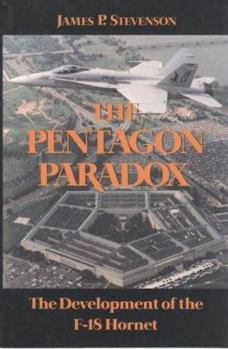
The Pentagon Paradox: The Development of the F-18 Hornet


Select Format
Select Condition 
Book Overview
This behind-the-scenes account of the development of the Navy's frontline strike fighter exposes the politics of high-stakes Pentagon weapon procurement. This description may be from another edition of this product.
Format:Hardcover
Language:English
ISBN:1557507759
ISBN13:9781557507754
Release Date:January 1993
Publisher:Naval Inst Pr
Length:445 Pages
Weight:1.96 lbs.
Dimensions:9.0" x 1.3" x 6.0"
Customer Reviews
5 ratings
I agree with Diane - What should I take away?
Published by Thriftbooks.com User , 16 years ago
I enjoyed reading this book. As a former Naval Officer charged with building/maintaining the infrastructure Naval Aviation uses coupled with my engineering background I find the historical aspects of Naval aviation to be a very interesting topic. While in the Navy I also became a Level II (Level III is where the big money is spent) contract officer which accorded me first hand experience of the acquisition process. I can relate the the issues and concerns which the author alluded to with procurement. What the author does not talk about is the issue of time which in major acqusitions is usually long. Time appears to be a major issue in the Navy's reluctance to prototype the F/A18E/F. Given the issues the Navy was having with the F-14 in the late '90's I'm not surprised that NAVAIR pushed the E/F Rhino through. Did the Navy really have an alternative? Especially for the F/A-18F. No more Tomcat, no more Intruder; what does the Carrier task force have left for power projection? Overall I found the book to be laced with facts and statistics which was enjoyable. I found the book lacking on conclusions and/or reccomendations. I can see how people have issues with the book but I can say I did not find the author making the same conclusions in some of the other reviews. I read the book rather fast (2 days) and probably need to read it again. Since I left the Navy and now work in a fortune 200 company, I can tell you that the issues we faced in the Navy are very similar to those faced by corporate America. Big projects suffer from scope creap and also seldom meet the requirements/needs for which they were approved. Individuals make careers on getting them completed and supporting the completion of the project regardless if it really works. I offer for reference any ERP project at a fortune 200 firm. But is that the point of the book? I can say after reading this book that I am much less a fan of the F-15 and F-14. I was never a fan of the F-18 only because of the "jack of all trades, master of none" philosophy. I would have enjoyed this book much more if the author took about 10 pages to write up his conclusions and then add a chapter which would allow for his perspective of what a Naval Air wing should look like. I found myself wanting for concusions or better yet, a specific point to the book. What should I learn from this book? That said I would reccomend this book to people who are: 1. Interested in the development of modern fighter aircraft 2. Interested in interservice rivalry challenges 3. Interested in understanding inertia against change in large beauracracies I would not reccomend this book to people who are: 1. Interested in making a case for the F-18, F-15 nor F-14 2. Interested in getting insights to improving the procurement process 3. Interested in debating issues/solutions facing our naval aviators and NAVAIR Strategy. If you are interested in modern aviation, this is a good read. My favorite quote: "Analysts are seen
confusing, comprehensive and engrossing look at defense acquisitions
Published by Thriftbooks.com User , 18 years ago
"The Pentagon Paradox", subtitled "The Development of the F-18 Hornet", goes beyond that, describing how our military wastes money on equipment paradoxically overpriced and underperforming. Not the most expensive or least efficient of America's warplanes, the F-18 stands out because it was intended to reverse the trend towards expensive and complicated planes, but ultimately became that kind of plane. James Stevenson's book is almost immediately partisan - he's got strong opinions about the shared Air Force and Navy addiction for aircraft needlessly sophisticated and too expensive to procure in reasonable number. Paradox begins in during the Viet Nam war, when we learned the bitter lesson of technology's limits. Despite the poor performance of the F-4- easily the world's most sophisticated fighter- both services commit millions to develop even more sophisticated successors. Instead of the USAF F-15 or the Navy's Tomcat, a cadre of officers known as "The Lightweight Fighter Mafia" press for a small low-cost fighter that can be built and maintained in large numbers while still preserving our technological edge. By 1977, ACEVAL/AIMEVAL exercises firmly demonstrate weaknesses in America's new warplanes. Knowing that they will never be rid of these expensive new jets, the Light-Mafia push for a light-weight fighter to "compliment" them. The eventual result is the "lightweight fighter competition" between the GD YF-16 and the Northrop YF-17, designed to select the LWF for the USAF and the Navy with the apparent intention of selecting the same plane for both services. In hindsight, given bitter inter-service rivalry, a smarter course would have been to have both services evaluate each aircraft in parallel. Instead, the USAF gets the first pick, leaving the Navy with the unenviable choice or either a "navalized" version of a rival service's choice or the loser of the competition. While the Navy's dilemma may sound more unpalatable than impenetrable (what's so bad about shipping out with carrier-ready F-16's? The USAF accepted versions of the Navy's Phantom and managed to do quite nicely), the title "Paradox" says it all. The Navy went out of its way to choose the loser and has been trying to hide the fact of its cost ever since. Stevenson shows how the Navy bent its own rules to make the F-18 carrier-ready - using double standards in such areas as landing speed, range, weight and "spotting factor" (which measures how much space an airplane will occupy while on a carrier deck) which should have given the F-16 the edge. The Hornet is so unsuitable that, according to a study cited by Stevenson, it would have cost us more to select it for both services than both selecting the F-16 for the USAF and developing a new plane for the Navy. The story doesn't end with the Hornet. Instead, the Navy will then spend billions in the early 1990's on a new Hornet, the F-18E. In some ways, the F-18E is simply a radical modification of older Hornets
ARGUMENT FOR THE FIGHTER MAFIA
Published by Thriftbooks.com User , 20 years ago
As a former military officer, I was curious about this book upon hearing about it from a friend in the Naval aviation community. I have seen factual evidence of this kind of procurement first hand. In fairness, all branches do it. The Army bought off on a very substandard Bradley (quasi-armored) for political reasons, for example. As I have no way of researching Stenvenson's facts, I keep an open mind but gauge that against my personal military experiences. After reading this book, I have to admit allegiance to the lightweight fighter mafia. America cannot afford 50-90 million dollar hyper complex fighters in limited numbers against aggressive factions that possess superior numeric air forces. I believe that the military should invest in a reality check as to where our dollars are being thrown. The quote "Where is Naval Aviation going?" really deserves in-depth consideration. Careers in the upper military ranks are being bolstered by people manuevering for political and monetary gain shamefuly at putting the lower ranks and our country at risk. Between the aerospace industry, the lobbyists, and the obscene amount of money involved, it shouldn't come as a shock that politics and corruption are rampant. I enjoyed the book and have already made multiple recommendations to other military officers and friends in the V-22 Osprey community.
How the Pentagon Aquistion plans fail
Published by Thriftbooks.com User , 22 years ago
First off Mr. Stevenson has a very big axe to grind and he does it with this book. If you can put that out of your head when you read this and understand it for what it is. That is how, by using the F-18 Hornet as an example, the Pentagon wants to buy simple but so many people put so much into what that item needs to do that it become so costly and overbudget that it is cheaper to continue to fund it and buy it then it is to trash it and start again. This book is dated to a point in that it was written just after the First Gulf War. But the ideas covered in how the Pentagon fails to buy its weapons right is still true. The biggest part of the axe to grind is about half way through the book when the reader finds out that Mr. Stevenson was very involved with this project as an Undersecretary in the late 70's going into the early 80's. So he knows to a point how some of the bitter congressional fighting went. He also finds a way to bite back as some of the (at the time) current Defense personnel that stood in his way. If you can over look this axe then this is a very good book. When added with how he has recently written about the A-12 Avenger II fiasco it does well as to provided some ideas on how to fix the purchasing of new weapons sytems and platforms.
Not the party line
Published by Thriftbooks.com User , 25 years ago
This book takes an indepth look at the F-18 history. But it does not assume that what the Department of Defense or the U.S. Navy claims is necessary true. The book gives a behind the scenes look at what really happened with the F-18 and how it became an aircraft less than it could have been.Anyone who wants to feel good about the F-18 should avoid reading this book. This tome is for those looking for what really happened and want a basis for understanding the process by which the military provides systems that often fall far short of their claims.
Copyright © 2025 Thriftbooks.com
Terms of Use | Privacy Policy | Do Not Sell/Share My Personal Information | Cookie Policy | Cookie Preferences | Accessibility Statement
ThriftBooks ® and the ThriftBooks ® logo are registered trademarks of Thrift Books Global, LLC
ThriftBooks ® and the ThriftBooks ® logo are registered trademarks of Thrift Books Global, LLC
