


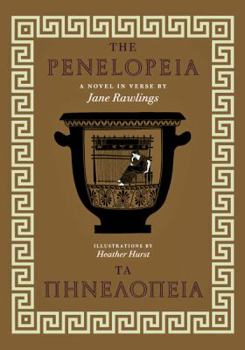
The Penelopeia

Select Format
Select Condition 
Book Overview
Recounted in a fast-moving, unrhymed free verse that both pauses and gallops, Ms. Rawlings pulls us back into the landscape and the culture of pre-Attic Greece. She makes us see how this tale might have unfolded if Penelope had been celebrated by Homer. She takes us on adventures that would confound even the cunning Odysseus, and brings herself and her daughters back intact to a husband who has been forever changed and a household that has survived her absence. It is a woman's tale unlike any that has ever been written and a high adventure.
Format:Hardcover
Language:English
ISBN:1567922066
ISBN13:9781567922066
Release Date:December 2003
Publisher:David R. Godine Publisher
Length:243 Pages
Weight:1.60 lbs.
Dimensions:0.9" x 7.0" x 10.1"
Related Subjects
American Literature Contemporary Fiction Literary Literature Literature & Fiction PoetryCustomer Reviews
3 ratings
Warp and Weft
Published by Thriftbooks.com User , 18 years ago
By now everybody knows that Homer was not a single person but rather a husband-and-wife writing team. Mr. Homer wrote the Iliad, with its incomparable action scenes, its earnest nobility, its chiseled-chin simplicity and unity. On the other hand, the layered ambiguity of the Odyssey, with its attention to psychological turmoil and its expressive secretiveness, could only have been the work of Mrs. Homer. Thus the large differences of syntax and vocabulary are explained. My sources suggest that Mrs. Homer had something of a reincarnated love affair with a scholar named Richmond Lattimore, a union which gave birth to Jane Rawlings, who inherited her mother's secrets and her father's literary style. The Penelopeia is therefore the grandchild so ardently desired by all. Rawlings certainly has both the manner and the flair for metaphorical language of Lattimore's translations of the Greek classics. Occasionally, one might wish that Rawlings had seen fit to write in her "mother's" tongue, since English lacks the metric sonority of Attic Greek. Without those thunderous cadences, The Penelopeia remains prose - very interesting prose, unlike any other except Lattimore's - but immune to the influences of modern English poetry. In short, this is a novel, with the novel structure of pseudo-epic free verse. As a novel, I enjoyed it a lot, and I won't give away any of its novelty. My only carping criticism would be that Telemachos in The Penelopeia doesn't seem to represent the same character as Telemachos in the Odyssey. Author's choice, of course, but I've always considered Telemachos the pivotal and by far the most appealing character in the old epic, as well as the most human. He's not such a subtle portrayal in the new epic.
A woman writes an epic poem ...
Published by Thriftbooks.com User , 18 years ago
A woman writes an epic poem ... and nobody notices. [I thank all of you polite & friendly Commentors for your support here -- you are much appreciated! And now apparently we can all look forward to some PLEASANT discussion from here on. Best wishes, amerye]
Takes you back 3000 years
Published by Thriftbooks.com User , 22 years ago
I thoroughly enjoyed this exciting tale of Odysseus's wife Penelopes enchanting adventures.The format is written in verse in the Homeric style lending it authenticity. Great read!!!
Copyright © 2026 Thriftbooks.com
Terms of Use | Privacy Policy | Do Not Sell/Share My Personal Information | Cookie Policy | Cookie Preferences | Accessibility Statement
ThriftBooks ® and the ThriftBooks ® logo are registered trademarks of Thrift Books Global, LLC
ThriftBooks ® and the ThriftBooks ® logo are registered trademarks of Thrift Books Global, LLC
