


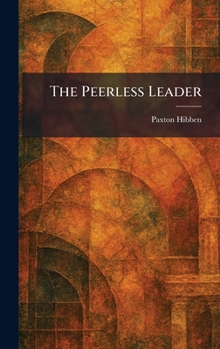
The Peerless Leader

"The Peerless Leader" is a detailed and insightful biography of William Jennings Bryan, a towering figure in American political history. This work chronicles the life of the three-time Democratic presidential nominee, examining his meteoric rise from a young Nebraska lawyer to a national icon of the populist movement. Known for his extraordinary oratorical skills, Bryan's career is defined by his passionate advocacy for the common man and his pivotal role in the "Free Silver" debate, most notably through his famous "Cross of Gold" speech.
The narrative explores the complexities of Bryan's character and his enduring influence on the United States. From his tenure as Secretary of State to his controversial participation in the Scopes Monkey Trial, the book provides a thorough account of his political and moral convictions. Author Paxton Hibben captures the essence of a man who, although never attaining the presidency, profoundly shaped the Democratic Party and the American political landscape at the turn of the 20th century. "The Peerless Leader" serves as an essential resource for understanding the populist impulses and religious fervors that have long animated American public life.
This work has been selected by scholars as being culturally important, and is part of the knowledge base of civilization as we know it. This work was reproduced from the original artifact, and remains as true to the original work as possible. Therefore, you may see the original copyright references, library stamps (as most of these works have been housed in our most important libraries around the world), and other notations in the work.
This work is in the public domain in the United States of America, and possibly other nations. Within the United States, you may freely copy and distribute this work, as no entity (individual or corporate) has a copyright on the body of the work.
As a reproduction of a historical artifact, this work may contain missing or blurred pages, poor pictures, errant marks, etc. Scholars believe, and we concur, that this work is important enough to be preserved, reproduced, and made generally available to the public. We appreciate your support of the preservation process, and thank you for being an important part of keeping this knowledge alive and relevant.
Customer Reviews
ThriftBooks® and the ThriftBooks® logo are registered trademarks of Thrift Books Global, LLC
