


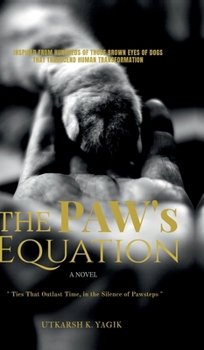
The Paw 's Equation

The Paws Equation is a novel about what we inherit from the dead when we are the ones who survived them. About the mathematics of guilt. About whether presence - sustained, costly, unreasonable presence - can constitute an act of love. It is, above all, a question the dog has already answered.
Warsaw, 1941. Marta Brenner is a German clerk inside the occupation - efficient, obedient, careful not to look too long at anything. Then a manuscript arrives, passed in secret by a man who studies one thing: what he calls the attending - the unreasonable, precise tendency of dogs to stay, to remain, to press their warmth against a human leg when leaving would cost them nothing. He believes it contains a proof. A truth about loyalty that predates every story ever told about love.When he vanishes into the machinery Marta helped operate, she walks out of Warsaw with his manuscript against her chest and his dog at her side.What follows is not an escape. It is a reckoning. The Paws Equation is a novel that contains a scientific theory, an intellectual argument, and a philosophical proposition, and integrates all three into its emotional architecture so completely that the reader experiences them not as ideas but as grief. The attending is not a metaphor. It is a proof. And the dog that demonstrates it for four hundred pages of wartime Europe is not a symbol. It is a presence.
For readers of ' The Tattooist of Auschwitz ', ' The Nightingale ', and ' A Man Called Ove '.
Customer Reviews
ThriftBooks ® and the ThriftBooks ® logo are registered trademarks of Thrift Books Global, LLC
