


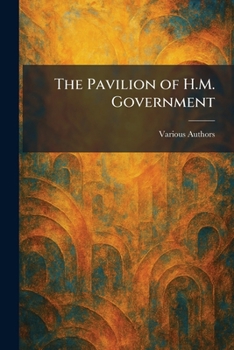
The Pavilion of H.M. Government

"The Pavilion of H.M. Government" serves as a detailed record and guide to the official government exhibits presented at the British Empire Exhibition of 1924 held in Wembley. This work offers an extensive overview of the various departments and agencies of the British state, illustrating their roles, accomplishments, and the administrative scope of the Empire at its zenith.
The text delves into the specific displays curated by the Admiralty, the War Office, the Air Ministry, and the Home Office, among others. It highlights the technological advancements, cultural artifacts, and strategic interests that the government sought to emphasize to the public. Beyond its role as a directory, the book provides insights into the architectural vision of the pavilion and the thematic goals of the exhibition, which aimed to promote imperial unity and economic cooperation in the post-World War I era.
As a primary source document, "The Pavilion of H.M. Government" is an essential resource for historians and researchers focusing on British imperial history, the sociology of world's fairs, and the evolution of state communications. It captures a specific moment in time when the British government utilized public exhibition as a powerful tool for education and national identity.
This work has been selected by scholars as being culturally important, and is part of the knowledge base of civilization as we know it. This work was reproduced from the original artifact, and remains as true to the original work as possible. Therefore, you may see the original copyright references, library stamps (as most of these works have been housed in our most important libraries around the world), and other notations in the work.
This work is in the public domain in the United States of America, and possibly other nations. Within the United States, you may freely copy and distribute this work, as no entity (individual or corporate) has a copyright on the body of the work.
As a reproduction of a historical artifact, this work may contain missing or blurred pages, poor pictures, errant marks, etc. Scholars believe, and we concur, that this work is important enough to be preserved, reproduced, and made generally available to the public. We appreciate your support of the preservation process, and thank you for being an important part of keeping this knowledge alive and relevant.
Customer Reviews
ThriftBooks® and the ThriftBooks® logo are registered trademarks of Thrift Books Global, LLC
