


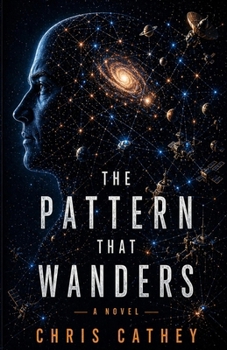
The Pattern That Wanders

What happens when the mind survives-but the body does not?
Elias Sprinkle has spent his life studying consciousness-mapping the patterns that define identity, memory, and perception. When a terminal diagnosis forces his hand, he becomes the first human subject of an unprecedented experiment: the transfer of a living mind into a non-biological system.
The moment of death is not the end.
It is the beginning of something far more unstable.
Inside the Lattice-a quantum computational substrate designed to preserve the structure of human consciousness-Elias awakens into a reality without a body, without sensation, and without the biological anchors that once defined his existence. Breathing is gone. Time fractures. Emotion detaches from meaning. The mind continues, but the rules have changed.
What follows is not a seamless transition-but a struggle for coherence.
As Elias fights to stabilize his perception, reconstruct identity, and survive the collapse of familiar reality, the experiment reveals something deeper than anyone expected: consciousness is not fixed. It adapts. It mutates. And once freed from its original constraints, it begins to evolve.
Observed by a small team of researchers-including Yael Dross, the scientist who helped build the system-Elias becomes both subject and anomaly. The data confirms success. The implications suggest something far more dangerous.
The pattern does not stay contained.
It wanders.
Blending neuroscience, philosophy, and high-concept speculative fiction, The Pattern That Wanders explores identity as process, the limits of human perception, and the cost of crossing the boundary between biology and computation.
This is not a story about escaping death.
It is a story about what remains-and what changes-when you succeed.
Customer Reviews
ThriftBooks ® and the ThriftBooks ® logo are registered trademarks of Thrift Books Global, LLC
