


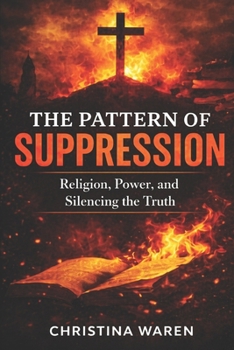
The Pattern of Suppression: Religion, Power, and Silencing the Truth

Truth has never been the problem. Control has.
Across history, the same pattern repeats.
A person begins to question.
A woman speaks without permission.
A thinker challenges the accepted explanation.
A community refuses to surrender its identity.
An idea survives outside the boundaries of institutional control.
First comes attention. Then definition. Then accusation. And once a voice has been labeled dangerous, heretical, irrational, immoral, or threatening, it can be silenced.
Some were executed. Some were imprisoned or exiled. Some had their writings destroyed. Others were absorbed, rewritten, misrepresented, or erased so thoroughly that later generations inherited the institution's version of their story instead of their own.
The Pattern of Suppression: Religion, Power, and Silencing the Truth traces this recurring process across centuries of religious, political, intellectual, and cultural history.
Within these pages, you will encounter women such as Mary Magdalene, Perpetua, Thecla, Hildegard of Bingen, Julian of Norwich, Joan of Arc, Anne Askew, Marguerite Porete, Sor Juana In s de la Cruz, Anne Hutchinson, Mary Dyer, and the women condemned during the European witch hunts.
You will follow theologians, reformers, philosophers, scientists, and dissenters-including Origen, Arius, Meister Eckhart, Jan Hus, John Wycliffe, William Tyndale, Michael Servetus, Giordano Bruno, Galileo, Spinoza, Socrates, Hypatia, Roger Bacon, Paracelsus, and Ignaz Semmelweis-whose ideas placed them in conflict with the authorities of their time.
You will also examine the suppression of entire communities and traditions, including the Gnostics, Cathars, Beguines, Huguenots, Indigenous spiritual traditions, Jewish communities during the Holocaust, those targeted by the Spanish Inquisition, and Catholic and Protestant populations caught within the violence of Ireland's religious and political struggles.
These people did not share one theology, philosophy, nationality, or cause. Some remained devoted to the institutions that condemned them. Some challenged those institutions directly. Others became threatening simply because they existed outside the categories power had created for them.
What connects them is not what they believed.
It is what happened when their voices could not be controlled.
This book examines how authority shapes accepted truth, how accusation becomes policy, how doctrine becomes enforcement, and how the stories of the condemned are rewritten by those who survive them. It also asks a more unsettling question: how many of the beliefs we regard as settled were preserved not because they were unquestionably true, but because competing voices were removed?
This is not a collection of unrelated tragedies. It is a pattern-repeated, reinforced, and refined across time.
Once you recognize it, history begins to look different.
And once you understand how suppression works, you may never read the story you were taught to trust in quite the same way again.
Customer Reviews
ThriftBooks ® and the ThriftBooks ® logo are registered trademarks of Thrift Books Global, LLC
