


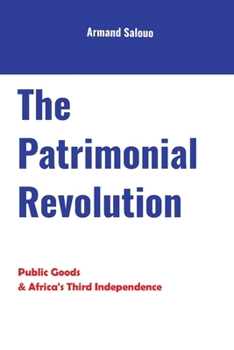
The Patrimonial Revolution: Public Goods & Africa's Third Independence
No Customer Reviews

Sixty years after political independence, Africa faces a defining institutional challenge: how to break cycles of corruption inherited from colonial structures of extraction? This book offers a bold answer: the constitutionalization of public goods as the foundation of Africa's third independence.Following political sovereignty in the 1960s and the pursuit of economic autonomy, this new independence would be patrimonial-ensuring that national resources, public services, and state enterprises remain inalienable collective assets.The Author demonstrates how patrimonial governance systems, deliberately designed by colonial administrations to enable private appropriation of public wealth, continue to structure contemporary corruption. Far from being a cultural failure, corruption emerges as an institutional legacy-and therefore institutionally reformable.Drawing on institutional economics and comparative constitutional law, the author charts concrete pathways prove that entrenching public goods in constitutions effectively protects national wealth from elite capture.
Format:Paperback
Language:English
ISBN:9956185078
ISBN13:9789956185078
Release Date:February 2026
Publisher:Cameroon Mountain Publishing
Length:154 Pages
Weight:0.63 lbs.
Dimensions:0.4" x 6.0" x 9.0"
Customer Reviews
0 rating
Copyright © 2026 Thriftbooks.com
Terms of Use | Privacy Policy | Do Not Sell/Share My Personal Information | Cookie Notice | Cookie Preferences | Accessibility Statement
ThriftBooks ® and the ThriftBooks ® logo are registered trademarks of Thrift Books Global, LLC
ThriftBooks ® and the ThriftBooks ® logo are registered trademarks of Thrift Books Global, LLC
