


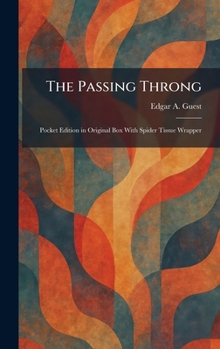
The Passing Throng: Pocket Edition in Original Box With Spider Tissue Wrapper

"The Passing Throng" is an evocative collection of verse by Edgar A. Guest, the beloved writer known as the "People's Poet." This work offers a heartfelt exploration of the human experience, capturing the joys, sorrows, and quiet triumphs of everyday life in early 20th-century America. Through his accessible and rhythmic style, Guest celebrates the virtues of friendship, the sanctity of the home, and the resilience of the individual spirit amidst the hustle and bustle of the world.
The poems within this volume serve as a mirror to the common soul, addressing universal themes such as fatherhood, labor, and the simple beauty of nature. Guest's writing is characterized by its profound optimism and moral clarity, providing readers with both comfort and encouragement. Each piece reflects a deep appreciation for the "throng" of humanity, finding dignity in the ordinary and wisdom in the routine tasks of life.
As a significant contribution to popular American literature, "The Passing Throng" remains a testament to Guest's ability to connect with a broad audience. His verses continue to resonate for their sincerity and their timeless reminder of the values that bind communities together, making this collection an essential read for those who appreciate sentimental and uplifting poetry.
This work has been selected by scholars as being culturally important, and is part of the knowledge base of civilization as we know it. This work was reproduced from the original artifact, and remains as true to the original work as possible. Therefore, you may see the original copyright references, library stamps (as most of these works have been housed in our most important libraries around the world), and other notations in the work.
This work is in the public domain in the United States of America, and possibly other nations. Within the United States, you may freely copy and distribute this work, as no entity (individual or corporate) has a copyright on the body of the work.
As a reproduction of a historical artifact, this work may contain missing or blurred pages, poor pictures, errant marks, etc. Scholars believe, and we concur, that this work is important enough to be preserved, reproduced, and made generally available to the public. We appreciate your support of the preservation process, and thank you for being an important part of keeping this knowledge alive and relevant.
Customer Reviews
ThriftBooks® and the ThriftBooks® logo are registered trademarks of Thrift Books Global, LLC
