


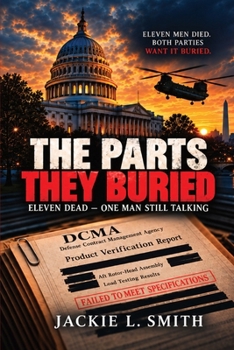
The Parts They Buried: Eleven Dead - One Man Still Talking

Eleven soldiers died when a Chinook went down over the Pacific. The Army called it mechanical failure. Frank Calloway is about to learn what that phrase was hiding.
Frank is Majority Staff Director of the Senate Armed Services Committee, a retired Navy Commander with fifteen years on Capitol Hill. He lives in a basement apartment on Walbridge Place behind the National Zoo with a yellow Labrador named Chief, starts his day at five-thirty, and has never once gone around the man he works for.
Then at 6:47 one morning, an old shipmate calls. Ray Sorensen's son, Staff Sergeant Danny Sorensen, was one of the eleven.
Eight days later, a report lands on Frank's desk with no cover memo, no liaison stamp, and no return address. It is a Defense Contract Management Agency audit of rotor-head assemblies that Vantage Defense Systems supplied to the Army. The company's own tests showed the parts failing below the contract specification. The results sent to the Army showed every part passing. The certification is signed by Tom Briggs, a former committee staffer Frank once trusted. When Frank calls him, Briggs says three sentences and hangs up. He says he cannot discuss it. Not that he will not. Cannot.
Chairman Raymond Howell tells Frank to document everything and wait. The defense authorization bill goes to the floor in nineteen days. It carries a pay raise for every man and woman in uniform, and Howell needs every vote he can count. If the Vantage story breaks first, the bill dies. Frank agrees to hold it. Then he finds twelve more assemblies missing from the paperwork, and he realizes that aircraft may be flying on them right now.
Frank follows the money through eight years of campaign filings. He follows serial numbers through an old Navy chief who now tracks Army helicopter parts. He meets Carol Voss, the minority staff director, in an empty corridor beneath the Senate, and he talks to a frightened Vantage engineer who will only testify under oath. Every door he opens shows him the same thing. Both parties have something to lose, and both are afraid of what a hearing would find.
Then, in the committee's own correspondence files, he finds a letter dated seven months before the crash. Two senators signed it, one from each party. Two more names are printed at the bottom. Frank knows at once that it changes everything, and that a man with a copy of it is no longer just a witness.
Ray Sorensen asked him one question in a kitchen in Boise, without anger, which was the worst part: is anybody going to be held accountable?
Frank has a notebook in which every entry carries a date and a time, a habit the Navy gave him. He has a dog who has never doubted a word he says. Against him are a Chairman who wants him quiet, a newspaper story that gets every number right and leaves out the one that matters, and a decision that will cost him either his career or his conscience.
The Parts They Buried is a gripping, realistic political thriller about loyalty, accountability, and the price of doing what is right when powerful people on both sides of the aisle want the truth to disappear. It is written for readers who enjoy Washington insider stories, military and veteran characters, and the slow, tightening pressure on one man who refuses to look away.
Eleven men died. Both parties want it buried. One man is still talking.
Customer Reviews
ThriftBooks ® and the ThriftBooks ® logo are registered trademarks of Thrift Books Global, LLC
