


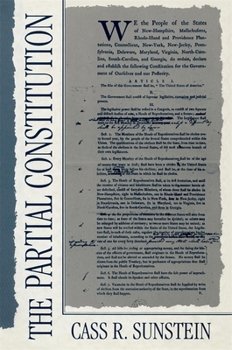
The Partial Constitution

Select Format
Select Condition 
Book Overview
Revised
Format:Paperback
Language:English
ISBN:067465479X
ISBN13:9780674654792
Release Date:August 1998
Publisher:Harvard University Press
Length:423 Pages
Weight:1.16 lbs.
Dimensions:1.1" x 6.1" x 9.2"
Customer Reviews
1 rating
A powerful contribution do constitucional doctrine
Published by Thriftbooks.com User , 23 years ago
When I was in my first years teaching constitutional law and writing a book on church and state in Portugal this book was perhaps the most important I read. The insights of Cass Sunstein helped to build a more persuasive case for religions freedom and equality in Portugal. Cass Sunstein addresses the constitutional question of determining the right baselines in those cases in which a Constitution confronts historically consolidated situations of inequality. In this cases, one must remember that the historical process is not necessarily a legitimate one. For instance (and this is where Sunstein'work was important to me), in Portugal the Catholic Church became the dominant religion, not by means of gentle persuasion in a free marketplace of ideas, but through coercion, persecution and discrimination. This means that the search for the right baseline for treating equally the different religious groups in contemporary Portugal cannot start with the acritical acceptance of the current situation of fact. If a Constitution accepts reality as it is, without any concern for how this reality came to be, this constitution will turn out to be a partial constitution. Much more could be said about it, but my point is that Sunstein's argument, developed trough many topics that have nothing to do with church and state problems, in fact helped to shape the current debate on church and state relations in Portugal, by focusing on the ilegitimate ways in which the dominant religion became so dominant and, by that, by allocating more theoretic and normative resources to the protection of religious minorities. After reading this book I've always tried to read everything I can from Sunstein. He is a great professor even when ocasionally I don't agree with him.
Copyright © 2026 Thriftbooks.com
Terms of Use | Privacy Policy | Do Not Sell/Share My Personal Information | Cookie Policy | Cookie Preferences | Accessibility Statement
ThriftBooks ® and the ThriftBooks ® logo are registered trademarks of Thrift Books Global, LLC
ThriftBooks ® and the ThriftBooks ® logo are registered trademarks of Thrift Books Global, LLC
