


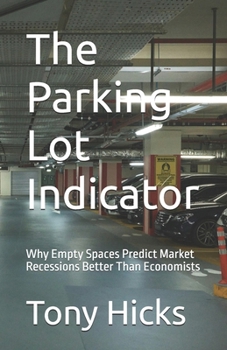
The Parking Lot Indicator: Why Empty Spaces Predict Market Recessions Better Than Economists

The Parking Lot Indicator: Why Empty Spaces Predict Market Recessions Better Than Economists presents a compelling case that some of the most accurate and immediate economic signals don't come from traditional financial models or institutional forecasts-but from the visible, behavioral patterns of everyday people. Drawing on satellite imagery, foot traffic data, and real-world case studies, the book shows how shifts in consumer routines-captured in empty parking lots at malls, office buildings, and retail centers-often precede official indicators of recession by weeks or even months. These physical spaces, once overlooked, serve as intuitive, real-time barometers of public sentiment, consumer confidence, and economic engagement.
The book goes deeper than just data, exploring the human psychology behind why people retract, delay, or avoid spending and movement during times of uncertainty. It reveals how fear, fatigue, and subtle behavioral shifts manifest visibly in our communities-long before anyone admits economic anxiety in surveys or models. Whether it's reduced dwell time, abandoned routines, or quiet weekday stillness in once-busy locations, these "soft signals" prove to be remarkably consistent early warnings. The parking lot becomes not just a metaphor but a mirror, reflecting the invisible decisions individuals make that ultimately ripple across the entire economy.
In its final chapters, the book calls for a fundamental rethinking of economic forecasting-urging institutions, investors, and analysts to combine traditional methods with behavioral, spatial, and observational intelligence. In an age where information is overwhelming and trust in models is low, it argues that visibility, intuition, and grounded observation are more critical than ever. By listening to the quiet signals-watching what people do, not just what they say-readers can better anticipate change and reconnect economic analysis with the world we actually live in. The message is simple but powerful: look at the lots, and you'll see what's coming.
Customer Reviews
ThriftBooks® and the ThriftBooks® logo are registered trademarks of Thrift Books Global, LLC
