


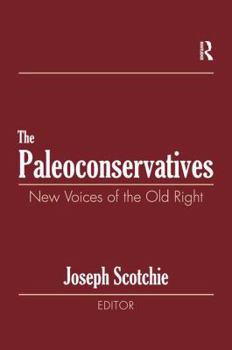
The Paleoconservatives: New Voices of the Old Right

Select Format
Select Condition 
Book Overview
"Paleoconservatism" as a concept came into circulation during the 1980s as a rejoinder to the rise of neoconservatism. It signifies a brand of conservatism that rose up in opposition to the New Deal, setting itself against the centralizing trends that define modern politics to champion the republican virtues of self-governance and celebrate the nation's varied and colorful regional cultures. This volume brings together key writings of the major representatives of "Old Right" thought, past and present.The essays included here define a coherent intellectual tradition linking New York libertarians to unreconstructed Southern traditionalists to Midwestern agrarians. Part I is devoted to the founding fathers of the modern conservative movement. Essays by Frank Chodorov, Murray Rothbard, and James Burnham attack economic aspects of the New Deal, big government in general, and high taxes. Russell Kirk introduces the cultural paleoconservatism, with its preference for social classes and distinctions of age and sex, while Richard Weaver explains why culture is more important to a civilization's survival than mere material conditions.The second part covers the contemporary resurgence of the Old Right. Chilton Williamson, Jr. sets out the argument against large-scale immigration on cultural and economic grounds. The divisive issue of trade is covered. William Hawkins outlines a mercantilist trade policy at odds with the free trade libertarianism of Chodorov and Rothbard. On education, Allan Carlson goes further than the Beltway Right in his advocacy of home schooling. M.E. Bradford shows how the doctrine of equality of opportunity inevitably leads to greater and more tyrannical state action. The contemporary culture wars are the focus of Thomas Fleming, Paul Gottfried, Clyde Wilson, and Samuel Francis, who search for the roots of American nationalism, the lessons to be drawn from the past, and how they may be applied in the future.
Format:Paperback
Language:English
ISBN:1138516597
ISBN13:9781138516595
Release Date:July 2017
Publisher:Routledge
Length:222 Pages
Weight:0.67 lbs.
Dimensions:0.5" x 6.0" x 9.0"
Customer Reviews
3 ratings
An anthology of Old Right political thought
Published by Thriftbooks.com User , 23 years ago
Joseph Scotchie notes that the term 'Paleoconservatism' arose in the 1980's, perhaps in opposition to the rise of the 'neoconservatism', which is the so called conservatism of the Beltway Right. 'Neoconservatism' was first articulated as an ideology by Irving Kristol who characterized himself as a "liberal mugged by reality." Neocons essentially accept the FDR New Deal, the Welfare State, an interventionist foreign policy, open borders and cosmpolitian internationalism, whereas paleoconservatives reject these instruments of big government.Paleoconservatism resonates with Middle America and stands opposed to not only liberalism, but to the pseudoconservatism of the Northeastern Establishment and the Beltway, which acquiesces with much of liberalism's vision for America. Neocons characterize themselves as realists and concede big government is here to stay, we just to need to capture its machinery and utilize it for our ends. Hence, the virtual abandonment of the idea lauded by Republicans in the 1980s to abolish the federal Dept. of Education. Now, in 21st century, they've told the Democrats we'll match your federal education appropriation and double it. Is it any wonder the Left is winning in this game of tug and war, neocons used to be just 2 decades behind liberals on what was acceptable. And today, well... sigh... The Old Right traces its early twentieth century roots to New Deal opposition. It was a diverse group to say the least, including classical republicans, populists, paleolibertarians, Midwestern agrarians and Southern traditionalists. There are schisms amongst modern day paleoconservatives over issues like free trade, however, those who articulate a free trade position often due so with reservations and remained opposed to free trade treaties and the WTO such as Congressman Ron Paul of Texas.Featured are essays from Russell Kirk, the father of twentieth century conservatism, who addresses the question of tradition and the relevance of class, status, religion and culture to American life. Murray Rothbard offers a tongue-in-cheek look at Life in the Old Right, which gives a window into the anti-FDR New Deal opposition. Populist economist William R. Hawkins defends a protectionist trade policy and sets out to prove the destructiveness of a free trade policy in his essay the Anti-History of Free Trade Idelogy. James Burnham, author of Suicide of the West, offers an essay on 'the managerial society.' Conservative thinker Allan Carlson offers his thoughts on education, home and family. Other essayist featured are Paul Gottfried, Richard Weaver and Clyde Wilson.The Paleoconservatives captures the essence of an authentic American conservatism. Certainly it has a divergent cast of characters with varying positions. However, their common commitment to classical republicanism, parochial regionalism and federalism generally bridges the gap. They hardly seek to play the all or nothing game the neoconservatives play in trying to articulate a '
Old Right Essays.
Published by Thriftbooks.com User , 23 years ago
_The Paleoconservatives_ contains essays from various Old Right thinkers and scholars that emphasize the traditional conservative outlook. Paleoconservativism emphasizes such aspects of society and culture as tradition, family life, religion, populism, nationalism, and protectionism as a trade policy. The paleoconservatives are firmly opposed to immigration, the welfare state, the New Deal and subsequent legislation, and often to free trade and unnecessary interventionist wars. Unlike many "neoconservatives" who have lost touch with the conservative tradition and now emphasize globalization, internationalism, and interventionism, the paleoconservatives have tried to retain a nationalist/isolationist outlook. These essays featuring such thinkers as Murray Rothbard, Frank Chodorov, James Burnham, Russell Kirk, Richard M. Weaver, Chilton Williamson Jr., William Hawkins, Allan Carlson, M. E. Bradford, Thomas Fleming, Paul Gottfried, Clyde Wilson, and Samuel Francis give a good introduction to the philosophy underlying the paleoconservative movement. Topics include a history of the Old Right, the immorality of taxation, the managerial state, traditional conservativism, immigration, the breakdown of the family and the need for home schooling, the distinction between a free trade and a protectionist policy, and the need for a new kind of nationalism. For those of us who see the sham of liberalism and modern day "neoconservativism", these essays offer some hope for a restoration of a traditional oulook opposed to modernism, multi-culturalism, internationalism, and modern day interventionism.
An important collection of paleoconservative essays
Published by Thriftbooks.com User , 25 years ago
This is a great collection of essays that captures true, classic conservatism, known also as paleoconservatism. Many so-called conservatives today are "neoconservatives," and the neocons have come to dominate the movement with their money and media access. Neocons are really liberals dressed up with conservative rhetoric, they seek to make liberal values and institutions more efficient, but not abolish them. Most of the founding fathers of the neoconservative movement are Jewish refugees from the Democratic Party of the 1970s. This collection of paleoconservative essays restores what the neocons have tried to stamp out: the traditionalism, nationalism, and populism of the American Old Right. One of the best essays is that of William Hawkins, who illustrates the difference between the 19th century liberals (today's libertarians) and conservatives on trade policy. Hawkins makes the crucial point that the free trader libertarians of the 19th c. might appear to be the allies of conservatives in opposition to big government, but that is only superficial because people have forgotten that in the 19th century the welfare state did not exist. This means that the libertarians were against the traditional (and legitimate) function of the state--preserving borders, a military, sovereignty, etc. In other words, the libertarians' true agenda is a cosmopolitan, borderless, one-world order in which there are no ties to home, to family, to race and culture, just hyperatomized individuals engaging in economic transactions. This insight alone into libertarianism is worth its weight in gold.
Copyright © 2026 Thriftbooks.com
Terms of Use | Privacy Policy | Do Not Sell/Share My Personal Information | Cookie Notice | Cookie Preferences | Accessibility Statement
ThriftBooks ® and the ThriftBooks ® logo are registered trademarks of Thrift Books Global, LLC
ThriftBooks ® and the ThriftBooks ® logo are registered trademarks of Thrift Books Global, LLC
