


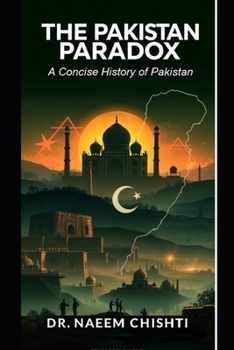
The Pakistan Paradox: A Concise History of Pakistan
No Customer Reviews

Pakistan is often described through the language of crisis-political turmoil, economic instability, security challenges, and social divisions. Yet this familiar narrative tells only part of the story. "The Pakistan Paradox" offers a deeper and more balanced account of a country whose history is as much about endurance and adaptation as it is about disruption.
This book presents a comprehensive and up-to-date history of Pakistan, tracing its roots from the ancient Indus Valley civilisation to the complex realities of the present day. It places particular emphasis on the modern state, examining how Pakistan has navigated the pressures of nation-building, governance, and global politics since its creation in 1947. Rather than treating history as a simple sequence of events, the book seeks to uncover the underlying forces that have shaped Pakistan's trajectory over time.
At the heart of the narrative is a central question: why has Pakistan, despite possessing strong state institutions, struggled to achieve stable and inclusive political development? The book argues that this tension-between a powerful state and a diverse, often fragmented society-lies at the core of Pakistan's historical experience. From the early years of independence to the present, this imbalance has influenced political decision-making, economic policy, and the relationship between citizens and the state.
The book is structured to guide the reader through both chronology and analysis. The opening chapters explore the deep historical foundations of the region, highlighting the cultural and political legacies that predate the formation of Pakistan. Subsequent sections examine the creation of the state, the challenges of early governance, and the crises that shaped its evolution, including the loss of East Pakistan in 1971. Later chapters focus on the transformations of the late twentieth and early twenty-first centuries, including military rule, democratic transitions, the impact of global conflicts, and the pressures of economic and environmental change.
What sets this book apart is its focus on enduring structures rather than isolated events. It examines the role of the military in shaping political outcomes, the evolution of the economy and its recurring vulnerabilities, the complex relationship between religion and the state, and the ongoing tensions between the centre and the provinces. By bringing these themes together, the book provides a framework for understanding not only what has happened in Pakistan, but why similar patterns continue to emerge.
The narrative also engages with recent developments up to 2026, including political upheaval, economic challenges, and the growing impact of climate change. These issues are placed within a longer historical context, allowing readers to see how contemporary crises are connected to deeper structural trends. At the same time, the book highlights areas of resilience and change, including the rise of a more connected and politically aware society, the expansion of media and public debate, and the potential for institutional reform. "The Pakistan Paradox" does not offer easy answers or simple conclusions. Instead, it presents Pakistan as a dynamic and evolving state, shaped by competing pressures and ongoing debates about identity, power, and governance. By examining these issues in a historical perspective, the book invites readers to move beyond surface-level explanations and to engage with the deeper forces that continue to shape one of the most important countries in South Asia.
At a time when Pakistan stands at a critical juncture, this book provides the context and insight needed to understand its past, interpret its present, and think more clearly about its future.
This book presents a comprehensive and up-to-date history of Pakistan, tracing its roots from the ancient Indus Valley civilisation to the complex realities of the present day. It places particular emphasis on the modern state, examining how Pakistan has navigated the pressures of nation-building, governance, and global politics since its creation in 1947. Rather than treating history as a simple sequence of events, the book seeks to uncover the underlying forces that have shaped Pakistan's trajectory over time.
At the heart of the narrative is a central question: why has Pakistan, despite possessing strong state institutions, struggled to achieve stable and inclusive political development? The book argues that this tension-between a powerful state and a diverse, often fragmented society-lies at the core of Pakistan's historical experience. From the early years of independence to the present, this imbalance has influenced political decision-making, economic policy, and the relationship between citizens and the state.
The book is structured to guide the reader through both chronology and analysis. The opening chapters explore the deep historical foundations of the region, highlighting the cultural and political legacies that predate the formation of Pakistan. Subsequent sections examine the creation of the state, the challenges of early governance, and the crises that shaped its evolution, including the loss of East Pakistan in 1971. Later chapters focus on the transformations of the late twentieth and early twenty-first centuries, including military rule, democratic transitions, the impact of global conflicts, and the pressures of economic and environmental change.
What sets this book apart is its focus on enduring structures rather than isolated events. It examines the role of the military in shaping political outcomes, the evolution of the economy and its recurring vulnerabilities, the complex relationship between religion and the state, and the ongoing tensions between the centre and the provinces. By bringing these themes together, the book provides a framework for understanding not only what has happened in Pakistan, but why similar patterns continue to emerge.
The narrative also engages with recent developments up to 2026, including political upheaval, economic challenges, and the growing impact of climate change. These issues are placed within a longer historical context, allowing readers to see how contemporary crises are connected to deeper structural trends. At the same time, the book highlights areas of resilience and change, including the rise of a more connected and politically aware society, the expansion of media and public debate, and the potential for institutional reform. "The Pakistan Paradox" does not offer easy answers or simple conclusions. Instead, it presents Pakistan as a dynamic and evolving state, shaped by competing pressures and ongoing debates about identity, power, and governance. By examining these issues in a historical perspective, the book invites readers to move beyond surface-level explanations and to engage with the deeper forces that continue to shape one of the most important countries in South Asia.
At a time when Pakistan stands at a critical juncture, this book provides the context and insight needed to understand its past, interpret its present, and think more clearly about its future.
Format:Paperback
Language:English
ISBN:B0GXZ81RT3
ISBN13:9798258199201
Release Date:April 2026
Publisher:Independently Published
Length:266 Pages
Weight:0.79 lbs.
Dimensions:0.6" x 6.0" x 9.0"
Customer Reviews
0 rating
Copyright © 2026 Thriftbooks.com
Terms of Use | Privacy Policy | Do Not Sell/Share My Personal Information | Cookie Policy | Cookie Preferences | Accessibility Statement
ThriftBooks ® and the ThriftBooks ® logo are registered trademarks of Thrift Books Global, LLC
ThriftBooks ® and the ThriftBooks ® logo are registered trademarks of Thrift Books Global, LLC
