


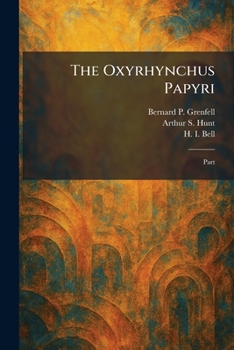
The Oxyrhynchus Papyri: Part

"The Oxyrhynchus Papyri Part" is a cornerstone of archaeological and classical scholarship, presenting a meticulous transcription and translation of ancient manuscripts recovered from the site of Oxyrhynchus, Egypt. This work documents the vast archaeological finds that have reshaped the modern understanding of the Greco-Roman world. Edited by the pioneering papyrologists Bernard P. Grenfell, Arthur S. Hunt, and H.I. Bell, the collection provides a window into the diverse administrative and literary life of antiquity.
This volume includes a wide array of documents, ranging from previously lost fragments of Greek literature to revealing records of daily life, such as private correspondence, legal contracts, and official government decrees. These texts provide an unparalleled glimpse into the social, economic, and cultural fabric of the Ptolemaic, Roman, and Byzantine eras. For historians, classicists, and linguists, "The Oxyrhynchus Papyri Part" is an essential resource, preserving the voices of ancient inhabitants that were nearly lost to time. Its scholarly rigor and historical depth make it a foundational text for anyone interested in the preservation of history and the evolution of the written word.
This work has been selected by scholars as being culturally important, and is part of the knowledge base of civilization as we know it. This work was reproduced from the original artifact, and remains as true to the original work as possible. Therefore, you may see the original copyright references, library stamps (as most of these works have been housed in our most important libraries around the world), and other notations in the work.
This work is in the public domain in the United States of America, and possibly other nations. Within the United States, you may freely copy and distribute this work, as no entity (individual or corporate) has a copyright on the body of the work.
As a reproduction of a historical artifact, this work may contain missing or blurred pages, poor pictures, errant marks, etc. Scholars believe, and we concur, that this work is important enough to be preserved, reproduced, and made generally available to the public. We appreciate your support of the preservation process, and thank you for being an important part of keeping this knowledge alive and relevant.
Customer Reviews
ThriftBooks® and the ThriftBooks® logo are registered trademarks of Thrift Books Global, LLC
