


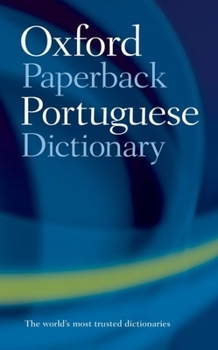
The Oxford Paperback Portuguese Dictionary


Select Format
Select Condition 
Book Overview
Designed for students, tourists and travelers, The Oxford Paperback Portuguese Dictionary is the most up-to-date Portuguese and English dictionary of its size available. It offers clear and concise translations of over 40,000 words and phrases in everyday idiomatic use, together with helpful information on grammar and usage. Careful labeling, with meaning, context, and usage signposted throughout, ensures that users can select the best translation for their needs. Both Brazilian and European Portuguese are covered, and pronunciation guidance is given for both Portuguese and English headwords. This outstanding dictionary is the perfect guide for anyone needing a quick and easy reference to the Portuguese language.
Format:Paperback
Language:English
ISBN:0198645287
ISBN13:9780198645283
Release Date:October 1996
Publisher:Oxford University Press, USA
Length:464 Pages
Weight:0.56 lbs.
Dimensions:1.0" x 4.4" x 7.0"
Customer Reviews
2 ratings
Excellent little dictionary
Published by Thriftbooks.com User , 20 years ago
I had to laugh when I read the review this dictionary had from a previous customer. Yes, it is Brazilian Portuguese, but that doesn't mean it is wrong Portuguese. Should I remind the other reviewer that American English is also different from British English? Which one is correct? It all depends of the country you are interested on. To the 180 million Brazilians like me, this little dictionary is very helpful. It is not only very accurate in its translations -which can be a problem on other dictionaries that translate only the literal sense of the word without taking in consideration its sense in a phrase - it is also full of words you would never find in a dictionary this size. I highly recommend this dictionary - to Brazilians, to born-English speakers interested in Brazilian Portuguese, and even to Portuguese people. Besides the spelling, regional, and cultural differences, let's not forget that Brazilians and Portuguese still speak the same language, still respect one another, and still able to understand each other, giving a little flexibility from both sides.
Coverage of Continental Portuguese Inadequate (EDITED)
Published by Thriftbooks.com User , 20 years ago
I removed my earlier review, so that it's rating would not affect the overall rating of this dictionary (when I tried to edit it, I found I could edit the text, but I couldn't change the rating). My major complaint about this dictionary is that its coverage of Continental Portuguese is inadequate, and for it to be said that "both Brazilian and European Portuguese are covered" is therefore misleading. The variances between the two are greater than Oxford leads the reader to believe. A good example of this is the Portuguese equivalent for "Hurry up!" Oxford provides "Ande logo!" as the equivalent for this, but my girlfriend tells me that that is thoroughly Brazilian. Yet Oxford doesn't indicate that this is the Brazilian expression. The Continental Portuguese for this is "Vem depressa!" or "Vem rápido!" EDIT (17 JUL 2008): Due to the recent passage of the Acordo Ortográfico (Orthographic Agreement - in other words, spelling agreement), the differences in spelling between Brazilian Portuguese and European/Continental Portuguese will soon disappear. This still presents some problems, however. Here's an example of what I mean: CURRENT ORTHOGRAPHY IN PORTUGAL, AFRICA, AND ASIA: De facto, o português é actualmente a terceira língua europeia mais falada do mundo. CURRENT BRAZILIAN ORTHOGRAPHY: De fato, o português é atualmente a terceira língua européia mais falada do mundo. You'll notice from the sentence above that in Brazil the word "fact" is "fato," while elsewhere in the Portuguese-speaking world it is "facto." Also, "actualmente" (PT and elsewhere)/"atualmente" (BR). AND NOW, THE REFORMED ORTHOGRAPHY, AS PROPOSED BY THIS AGREEMENT: De facto/fato, o português é atualmente a terceira língua europeia mais falada do mundo. (Translation: "Indeed, Portuguese is currently the third-most spoken European language in the world.") The word "fact" (facto/fato) is one of the big problems with this agreement. Why? Because in Portugal, Africa, and Asia, "fato" means clothes or a suit (as in a business suit). In Brazil, it does not. This is why, in the Reformed Orthographic example given above, you see both "fato" and "facto." The present agreement seems to think that it's best to not address this problem. This agreement needs lots of work, yet it has been passed into law. There are those in Portugal, my girlfriend included, who look at this agreement as "linguistic terrorism," because it FORCES changes upon the language, rather than to allow it to change NATURALLY. American English sounds different from British English, for example, largely because of the distance between the two nations (although there are some American accents which have a close relationship to British). The same is true of the differences between Brazilian pronunciation over Portuguese pronunciation. American spelling differences came about largely because those who created the first American dictionaries wanted the language to reflect its informality as compared to the formality of p
Copyright © 2026 Thriftbooks.com
Terms of Use | Privacy Policy | Do Not Sell/Share My Personal Information | Cookie Policy | Cookie Preferences | Accessibility Statement
ThriftBooks ® and the ThriftBooks ® logo are registered trademarks of Thrift Books Global, LLC
ThriftBooks ® and the ThriftBooks ® logo are registered trademarks of Thrift Books Global, LLC
