


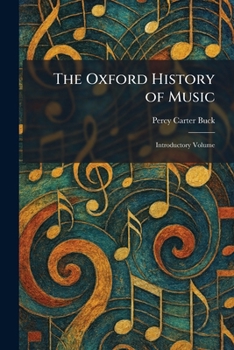
The Oxford History of Music: Introductory Volume

"The Oxford History of Music: Introductory Volume" serves as an essential foundation for one of the most significant scholarly examinations of Western musical development. Edited by Sir Percy Carter Buck, this volume provides the critical context necessary for understanding the broad sweep of musical evolution, from its ancient origins through the complex developments of the modern era.
The work explores the fundamental principles of musicology, examining the relationship between acoustics, aesthetics, and the historical progression of musical forms. It addresses the technical and social influences that have shaped the art of sound, offering readers a comprehensive overview of how musical expression has evolved across centuries. By synthesizing theory with historical analysis, Buck creates a cohesive starting point for both students and aficionados of classical music.
As a key entry in a landmark series, this volume remains a valuable resource for its insights into the philosophical and structural underpinnings of the Western canon. It bridges the gap between technical music theory and historical narrative, ensuring that the reader is well-equipped to explore the subsequent detailed volumes of this monumental series.
This work has been selected by scholars as being culturally important, and is part of the knowledge base of civilization as we know it. This work was reproduced from the original artifact, and remains as true to the original work as possible. Therefore, you may see the original copyright references, library stamps (as most of these works have been housed in our most important libraries around the world), and other notations in the work.
This work is in the public domain in the United States of America, and possibly other nations. Within the United States, you may freely copy and distribute this work, as no entity (individual or corporate) has a copyright on the body of the work.
As a reproduction of a historical artifact, this work may contain missing or blurred pages, poor pictures, errant marks, etc. Scholars believe, and we concur, that this work is important enough to be preserved, reproduced, and made generally available to the public. We appreciate your support of the preservation process, and thank you for being an important part of keeping this knowledge alive and relevant.
Customer Reviews
ThriftBooks® and the ThriftBooks® logo are registered trademarks of Thrift Books Global, LLC
