


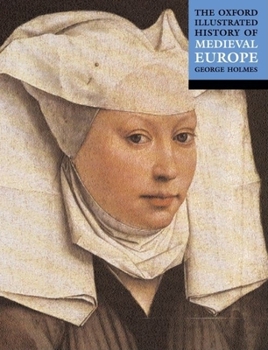
The Oxford Illustrated History of Medieval Europe


Select Format
Select Condition 
Book Overview
Covering a thousand years of history, this richly illustrated volume tells the story of the creation of Western civilization in Europe and the Mediterranean. Written by expert scholars and based on the latest research, it offers the most authoritative account of life in medieval Europe from the fall of the Roman Empire to the coming of the Renaissance.
Exploring a period of profound diversity and change, the contributors focus on all aspects of medieval history from the empires and kingdoms of Charlemagne and the Byzantines to the new nations which fought the Hundred Years War; from the expression of religion in the great monasteries and cathedrals to the mixed ambitions of the Crusades; and from the cultural worlds of chivalric knights, popular festivals, and new art forms to the social catastrophe of the Black Death. Depicting both the strange and the familiar, they reveal that the vast upheavals of migration and new institutions of the Dark Ages between 400 and 900 far surpass anything we have endured today. Consequently, the new attitudes and ways of life that developed from 900 to 1500 remain central in modern societies. Our towns and villages, the nation state and democratic forms of government, our commerce and banking, our system of education, our literature, and our concern with the relationship between the physical and the spiritual--these all had their origins in the medieval world.
Divided between the Mediterranean world and northern Europe, the six chapters in this book demonstrate the movement of the center of gravity in European life from the Mediterranean to the north. Lavishly illustrated with over two hundred illustrations, including twenty-four in color, the volume also contains comprehensive reference material in maps, genealogies, a chronology, lists of further reading, and a full index.
Exploring a period of profound diversity and change, the contributors focus on all aspects of medieval history from the empires and kingdoms of Charlemagne and the Byzantines to the new nations which fought the Hundred Years War; from the expression of religion in the great monasteries and cathedrals to the mixed ambitions of the Crusades; and from the cultural worlds of chivalric knights, popular festivals, and new art forms to the social catastrophe of the Black Death. Depicting both the strange and the familiar, they reveal that the vast upheavals of migration and new institutions of the Dark Ages between 400 and 900 far surpass anything we have endured today. Consequently, the new attitudes and ways of life that developed from 900 to 1500 remain central in modern societies. Our towns and villages, the nation state and democratic forms of government, our commerce and banking, our system of education, our literature, and our concern with the relationship between the physical and the spiritual--these all had their origins in the medieval world.
Divided between the Mediterranean world and northern Europe, the six chapters in this book demonstrate the movement of the center of gravity in European life from the Mediterranean to the north. Lavishly illustrated with over two hundred illustrations, including twenty-four in color, the volume also contains comprehensive reference material in maps, genealogies, a chronology, lists of further reading, and a full index.
Format:Paperback
Language:English
ISBN:0192852205
ISBN13:9780192852205
Release Date:September 1990
Publisher:Oxford University Press
Length:414 Pages
Weight:2.39 lbs.
Dimensions:9.6" x 0.9" x 7.4"
Customer Reviews
6 ratings
Promising but a bit disappointing
Published by Paulo , 2 years ago
Illustrations are rich but the book has a continuity problem as authors jump huge lengths from one sentence to the other, making it superficial and hard to follow.
Leading Overview Edition
Published by Direct Current , 3 years ago
With lots of pictures, high scholarly standards, and breadth. Good starting point with an excellent FURTHER READINGS section for areas of interest after taking in the landscape.
The Oxford Illustrated History of Medieval Europe (Oxford Illustrated Histories)
Published by Thriftbooks.com User , 16 years ago
The Oxford Illustrated History of Medieval Europe (Oxford Illustrated Histories) is very helpful and I love the richness of the pictures.
Excellent Basic Introduction.
Published by Thriftbooks.com User , 17 years ago
This survey of the history of Medieval Europe consisting of separate topical essays in chapter form and is an excellent basic introduction. In such a short volume it is difficult to provide a fully comprehensive look at Medieval Europe, but this book comes close. It should be read by any reader either embarking on the study in detail of the Medieval Europe or one who has read a couple in-depth treatments but desires an overview. Overall this book is a solid introduction to some of the most important historiography and is an excellent fundamental introduction. I highly recommend it.
Oxfprd History
Published by Thriftbooks.com User , 17 years ago
Good Book to take an overall look at Medieval History, pleased with the time it took to get it and the condition of the book>
Good overview of Medieval Europe and the Mediterranean basin
Published by Thriftbooks.com User , 19 years ago
According to George Holmes, editor of _The Oxford History of Medieval Europe_, "western civilization was created in medieval Europe." Much of modern thought and culture, including the modern nation state, ideas of popular sovereignty, modern parliaments, banking, universities that award degrees, and the literary form of the novel, has its origins in the struggles and society of the medieval centuries. Since 1500 nothing comparable to the shattering and rebirth of the West that happened between the years 400 and 900 has occurred, nor has arisen anything as fundamentally novel and distinct as the culture that grew up around the cathedrals, universities, royal courts, and commercial cities between the years 900 and 1500. This book is an anthology and is divided into eight sections; an editor's forward and an editor's postscript, both by Holmes, and six chapters, each by a different author and each concerned with a different era and region of medieval Europe (chapters focus on either the Mediterranean basin or northern Europe beyond the Alps and the Pyrenees). In addition to the text there were a number of plates depicting medieval art and around twenty very helpful maps throughout the book. Chapter one was on the transformation of the Roman Mediterranean into that of the early medieval era (400 to 900) and was by Thomas Brown. Main themes are the rise and long, slow decline of the Byzantine Empire and what Brown called the "age of invasions," the upheaval in the region caused by the arrival of Germanic peoples (notably the Lombards, the most devastating), the Slavs, the Persians (a revitalized Persian empire, though eventually defeated by Emperor Heraclius, did lead to a failure of the Byzantines to reestablish authority over Italy and the Balkans), and the Arabs. Islam had phenomenal success due to the struggle between the Persians and the Byzantines, the abilities and dedication of its soldiers, the political prowess of the early caliphs, the simple appeal of its doctrines, and the political and religious alienation of Byzantium's subjects. Also of great importance was the growing power and independence of the pope (thanks in large part due to the Franks, beginning with Charlemagne), vital in creating a distinctive Western Europe, different politically, ecclesiastically, and culturally from Byzantium (other factors in fostering a distinct Western identity were the collapse of land trade routes and the growing linguistic cleavage). Chapter two dealt with northern Europe in the Dark Ages (400 to 900) and was written by Edward James. In this period the north found "its own voice," as thanks to the spread of Christianity (and writing) northerners began to produce their own written record, allowing the north to emerge "into the light of history" for the first time, as Romanization (the spread of writing, ideas of law and government, and Greek and Latin knowledge) continued ironically after the collapse of the actual Roman Empire. As with the p
Copyright © 2025 Thriftbooks.com
Terms of Use | Privacy Policy | Do Not Sell/Share My Personal Information | Cookie Policy | Cookie Preferences | Accessibility Statement
ThriftBooks ® and the ThriftBooks ® logo are registered trademarks of Thrift Books Global, LLC
ThriftBooks ® and the ThriftBooks ® logo are registered trademarks of Thrift Books Global, LLC
