


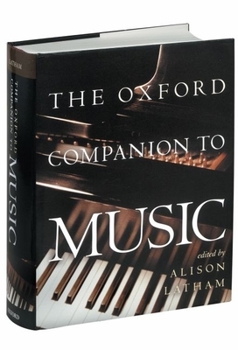
The Oxford Companion to Music


Select Format
Select Condition 
Book Overview
First published in 1938, The Oxford Companion to Music has been the first choice for authoritative information on all aspects of music. Now, 17 years since the last edition, the Companion is here to serve a new generation of students, teachers, performers, concert goers, record collectors, and music lovers.
Completely revised and updated by a distinguished team of contributors, the Oxford Companion to Music features more than 1,000 new entries than the previous edition; more than 70 percent of the entire text is either new or entirely rewritten. Here, in articles that range from clear, concise definitions of musical ideas and terms to extended surveys of musical forms and styles, is authoritative coverage of virtually every musical subject. Embracing the world of music in all its variety--including jazz, popular music, and dance--the Companion offers a concentrated focus on the Western classic tradition, from the Middle Ages to the present day.
More than 8,000 articles sweep across an extraordinary range of subjects: composers, performers, conductors, individual works, instruments and notation, forms and genres. From the study of music--theory, aesthetics, scholarship--to the way it is performed and disseminated, the Companion provides comprehensive, accessible coverage of music in all its artistic, historical, cultural, and social dimensions.
Comprehensive, authoritative, up-to-date, and designed throughout for clarity and accessibility, the new Oxford Companion to Music, like every edition before it, will immediately become an indispensable resource for all who wish to enrich their love and knowledge of music.
Completely revised and updated by a distinguished team of contributors, the Oxford Companion to Music features more than 1,000 new entries than the previous edition; more than 70 percent of the entire text is either new or entirely rewritten. Here, in articles that range from clear, concise definitions of musical ideas and terms to extended surveys of musical forms and styles, is authoritative coverage of virtually every musical subject. Embracing the world of music in all its variety--including jazz, popular music, and dance--the Companion offers a concentrated focus on the Western classic tradition, from the Middle Ages to the present day.
More than 8,000 articles sweep across an extraordinary range of subjects: composers, performers, conductors, individual works, instruments and notation, forms and genres. From the study of music--theory, aesthetics, scholarship--to the way it is performed and disseminated, the Companion provides comprehensive, accessible coverage of music in all its artistic, historical, cultural, and social dimensions.
Comprehensive, authoritative, up-to-date, and designed throughout for clarity and accessibility, the new Oxford Companion to Music, like every edition before it, will immediately become an indispensable resource for all who wish to enrich their love and knowledge of music.
Format:Hardcover
Language:English
ISBN:0198662122
ISBN13:9780198662129
Release Date:January 2002
Publisher:Oxford University Press
Length:1448 Pages
Weight:4.65 lbs.
Dimensions:2.4" x 7.8" x 9.4"
Age Range:13 to 17 years
Grade Range:Grades 8 to 12
Customer Reviews
2 ratings
Better or Worse than its Predecessor?
Published by Thriftbooks.com User , 21 years ago
I've been comparing The Oxford Companion to Music, ed. Alison Latham (2002; 1,434 pages) with its immediate predecessor: The New Oxford Companion to Music, ed. Denis Arnold (1983; 2 volumes, 2,017 pages). In the estimable series of Oxford Companions you can usually expect the new edition to supersede and replace the old one. In this case, however, it's not that simple. A glance at the above reveals that the new edition, in one volume, is some 583 pages shorter than the preceding edition, in two volumes. Losing almost 600 pages of 2,000 represents a very substantial loss of material. Moreover, when we examine the two editions, we discover that the 1983 edition is lavishly, indeed beautifully, illustrated ("1,100 halftone illustrations and line drawings, 405 music examples"). None of the illustrations are in color, but there is an abundance of well-chosen, functional, illuminating photos, portraits, paintings, manuscripts, figures, line drawings, plates, tables, musical examples. The new edition of 2002, alas, has virtually eschewed illustration: almost all of the illustrations of the 1983 edition have been scrapped. We get a comparative handful of musical examples and figures, but just about everything else has been eliminated; even the greatest composers aren't represented by a single likeness, whereas in the 1983 edition even lesser composers get a photo or portrait. If for example you want to understand what an accordion is, there is no substitute for a picture of one. The 1983 edition has a 4-page entry on "accordion," with photos of four different types (including a musician playing one), plus 2 explanatory diagrams. The 2002 edition has a page-length entry with no illustrative material at all. I find this a significant loss, a significant cheapening of the book, and a significant diminution in the pleasure of using it. It's revealing that Alison Latham, the 2002 editor, refers to the "wealth of illustrative material" as one of the assets of Denis Arnold's 1983 edition, but makes no mention of the fact that she has thrown out almost all of it. But that's not all. If for example we look up "organ" in the 1983 edition, we find a truly comprehensive 20-page entry, with 20 illustrations (plates, figures, tables, drawings, photos). In the 2002 edition we find a 6-page entry with 8 figures; this represents a radical abridgment of the earlier article. Could "organ" be an unhappy fluke? No, unfortunately it's not. I looked up "trumpet," "violin," and "piano," and found the same result in each case: a truly drastic loss of material, both text and illustration, in the new edition. If you look up any of the hundred standard repertory operas in the 1983 edition, you find the basic facts about composer, librettist, and premiere, plus a synopsis of the action, and often an apt illustration and "Further Reading" suggestions. If you look up any of the same operas in the 2002 edition, you find a very short entry (Carmen, for exam
Excellent reference for those who love classical music
Published by Thriftbooks.com User , 23 years ago
The Oxford Companion to Music is an excellent reference work for those who love classical music. It's probably not detailed or technical enough for most professional musicians; but those who enjoy listening to the endless variety and vast range of emotions of classical music (that's a plug!) will find the OCM can considerably enhance their enjoyment. This is a big work of 1,434 pages; but the typeface, while small, is well-chosen. It's clean and clear; even these old eyes read it with no difficulty. There are extended articles on famous conductors and all the major composers plus numerous others that you never heard of. The biographies are helpful in placing a composer's works in the context of his life. Especially helpful is a well-chosen but unannotated bibliography after most of the biographies. There are also major articles on different forms of music, types of instruments, etc. I thought I knew a lot about the sonata form, but I know more now after reading that article. There is almost no analysis of individual works; to include them would probably have doubled the size of this work. I've used a number of classical reference works over the years, but the OCM is easily the best. It's complete enough so as not to oversimplify too drastically but not so long that "you learn more about penguins that you really want to know."
Copyright © 2026 Thriftbooks.com Terms of Use
| Privacy Policy | Do Not
Sell/Share My Personal Information | Cookie Policy | Cookie Preferences | Accessibility Statement
ThriftBooks® and the ThriftBooks® logo are registered trademarks of Thrift Books Global, LLC
ThriftBooks® and the ThriftBooks® logo are registered trademarks of Thrift Books Global, LLC
