


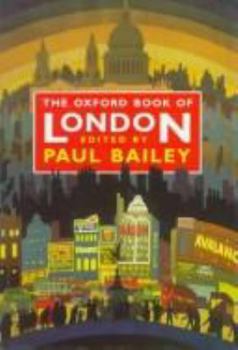
The Oxford Book of London

Select Format
Select Condition 
Book Overview
All great cities inspire great literature, but no other city has so consistently stimulated the literary imagination as London. Over the centuries writers, poets, historians, artists, and simple observers have chronicled the life and growth of the capital from its humble beginnings to the teeming metropolis it is today. In his sparkling anthology Paul Bailey has captured the essence of London's allure for visitors and inhabitants--from the Middle Ages to the present day--with wit, humor, and pathos.
Among the many contributors are those whose evocations of the city have forever fixed it in the popular mind: Charles Dickens's descriptions of fogbound London streets, the bustle and hustle of the Victorian city; Ben Jonson's satires on London low life from 1616; William Wordsworth rhapsodizing on the view from Westminster Bridge; George Bernard Shaw's archetypal Cockney, Eliza Doolittle. Less well known but equally vivid are descriptions of everyday life for the down and out and the aristocrat, of the museums, theaters, galleries and churches, the restaurants and pubs, the parks and institutions, the topography of London mapped out in unforgettable verse and prose. The great set pieces, Daniel Defoe's description of the Plague year, John Evelyn's and Samuel Pepys's daily records of the Great Fire, join eyewitness accounts of coronations and funerals, unequaled in their immediacy. The bemusement of foreign visitors, the joys and horrors of London buses and the London Underground, the sprawl of the suburbs and the excitement of the city, all add to the dazzling panorama.
Beginning in 1180 or thereabouts, with a monk named William Fitzstephen enumerating the delights of the capital, and ending in the present day, The Oxford Book of London offers an unparalleled introduction and tribute to this fascinating city. Armchair travellers, anyone planning to visit London, and those interested in fine writing will gain a sense of the ways in which the city has grown and changed over eight centuries.
Among the many contributors are those whose evocations of the city have forever fixed it in the popular mind: Charles Dickens's descriptions of fogbound London streets, the bustle and hustle of the Victorian city; Ben Jonson's satires on London low life from 1616; William Wordsworth rhapsodizing on the view from Westminster Bridge; George Bernard Shaw's archetypal Cockney, Eliza Doolittle. Less well known but equally vivid are descriptions of everyday life for the down and out and the aristocrat, of the museums, theaters, galleries and churches, the restaurants and pubs, the parks and institutions, the topography of London mapped out in unforgettable verse and prose. The great set pieces, Daniel Defoe's description of the Plague year, John Evelyn's and Samuel Pepys's daily records of the Great Fire, join eyewitness accounts of coronations and funerals, unequaled in their immediacy. The bemusement of foreign visitors, the joys and horrors of London buses and the London Underground, the sprawl of the suburbs and the excitement of the city, all add to the dazzling panorama.
Beginning in 1180 or thereabouts, with a monk named William Fitzstephen enumerating the delights of the capital, and ending in the present day, The Oxford Book of London offers an unparalleled introduction and tribute to this fascinating city. Armchair travellers, anyone planning to visit London, and those interested in fine writing will gain a sense of the ways in which the city has grown and changed over eight centuries.
Format:Hardcover
Language:English
ISBN:0192141929
ISBN13:9780192141927
Release Date:April 1996
Publisher:Oxford University Press
Length:396 Pages
Weight:1.41 lbs.
Dimensions:9.5" x 1.1" x 6.4"
Customer Reviews
1 rating
Definitive London
Published by Thriftbooks.com User , 23 years ago
Well, perhaps not definitive London, but a good collection nonetheless. Like most modern histories of London, the books pays only cursory attention to the period prior the Norman Conquest; there is a simple reason for this -- not much exists text-wise to give account of life, history, etc. prior to this time. The Oxford Book of London, edited by Paul Bailey, is divided into three sections: Part I, Twelfth to Eighteenth Century London; Part II, Nineteenth Century London; and Part III: Twentieth Century London. Part I includes observations and rememberings of monks, poets, diplomats, clerics, and royals (being the major divisions of literate people during the 12th to 18th centuries). Included are visions of Chaucer and Shakespeare, Nashe and Donne, Jonson and Herrick, Hobbes and Pepys. The texts include passages from person diaries and newspaper headlines such as 'A Whale in London' circa 1658. All sides presented, as a perusal of headlines will show: "A Revel! A Revel!' balances 'An Absolute Hell on Earth'. Here you will be introduced to (or reminded of) Wat Tyler, Moll Flanders, John Boswell; you'll walk the streets as seen by Mozart and Haydn. Part II narrows the focus a bit, and when most people think about 'Old London', it is in fact this period of time to which most of them harken back. The nineteenth century saw London's explosive growth and true development as an imperial world city. In 1834 Thomas de Quincey published 'The Nation of London'; excerpts are here. Wordsworth and Blake wrote of London during this period, as did Keats and Thackeray (his 'How to live well on nothing a year' is wonderful). This is also the London of Dickens and Sherlock Holmes, perhaps the two visions of London that endure most. The rise of popular press also took hold during this period -- the true miracle here of this section is that it does not go on for a thousand pages. Part III is a similar miracle. London is established, in many ways a city of unparalleled urban blight (Jack London--hmmm, where do you suppose he got that name?--called it a 'vast and malodorous sea'). Shaw's post-Victorian London images remain firm in our minds, as does E.M. Forster's; T.S. Eliot describes London as an 'Unreal City', yet, for the fire wardens during the war, the city was far too real, and far too flammable. One is inclined to agree that London is in many ways the 'Capital of all Capitals', to quote Steen Eiler Rasmussen (1937), and yet, while there is hopefulness in the latest visions of London, there is also a sadness and an underlying fear that perhaps the best days are behind.
Copyright © 2026 Thriftbooks.com
Terms of Use | Privacy Policy | Do Not Sell/Share My Personal Information | Cookie Policy | Cookie Preferences | Accessibility Statement
ThriftBooks ® and the ThriftBooks ® logo are registered trademarks of Thrift Books Global, LLC
ThriftBooks ® and the ThriftBooks ® logo are registered trademarks of Thrift Books Global, LLC
