
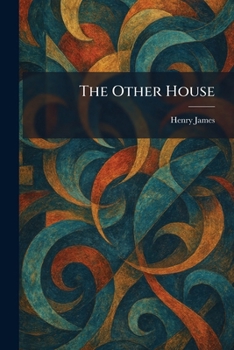
The Other House is a novel by Henry James, first published in 1896. Set in England with its plot revolving around a murder, the novel is seen as an oddity in the James canon of books. Henry James method of writing from a character's point of view allowed him to explore issues related to consciousness and perception, and his style in later works has been compared to impressionist painting. His imaginative use of point of view, interior monologue and unreliable narrators brought a new depth to narrative fiction.
I find it hard to believe that Henry James knew how to ratchet up the tension in this clever way--at times, too cunning--but it should come as no surprise that there is a darkness, an insanity like murder beneath the surface of the most proper British households, in this case, the people from "The Other House." The tension of the novel comes from James knowing how to keep the lid on, so to speak, and when to let some steam drift out. His art is in the way the characters hold back or speak out, conceal and reveal. In The Other House, one can hear the approach of his future masterpieces, The Golden Bowl, The Ambassadors, and The Wings of the Dove. But there is something about this novel that makes it closer to "easy" reading than any of his novels I know. The Other House is surprisingly entertaining, and mostly dialogue--a result, probably, of his play-writing experience, but also because in the 1890s upper-class people still went to great lengths to conceal their sexual desires beneath lovely sentences. At times, James makes even the most disciplined reader (moi) wait too long for key facts--more so in this novel than others. I was irritated that he didn't make it clear that Mrs. Bream's first name is Julia and that Miss Armiger's first name is Rose. The name Jean Martle is repeated too much, and I always got the names of the houses mixed up; Eastmead is one, and Bounds must be the "other" of the title, from Mrs. Beever's point of view. The two houses and two families, partners in a single large banking firm, made their money from overseas colonies. And the man who seeks to marry Rose, Dennis Vidal, spends a lot of time in China, where, apparently the British system allowed for a lot of fortune-making. But the women have money, too, and so husband-hunting is not the problem when so many women focus their laser-beam of attention on the charismatic Tony Bream. But there is something strange, some plot twist that is almost too, too forced in this novel. True, there are seven adults with complex psychological setups, but the women are over-wrought, over-determined, and over-drawn. Mrs. Beever's suspicious mind, I can see; she's older and on the look out, protecting her marriageable son, Paul, and her banking interests, and above all, her business partner, Tony. But Julia Bream and Rose Armiger are fine knots of nerves, over-excitable, and given to wild thoughts and actions; perhaps James tried to explain this by giving Julia and Rose a stepmother who was a kind of emotional terrorist, who made their girlhood toxic. (We never see Julia Bream nor the stepmother; Julia is bed-ridden and her words are reported through the filter of other's apprehension.) I've heard it said that Sigmund Freud's patients were created during the 1890s; now I see it, through Henry James. Dr. Ramage, who attends Julia, is a point of stable reference, and toward the end of the novel, I thought he was going to summon the police to investigate the murder scene.
A surprisingly quick read
Published by Thriftbooks.com User , 22 years ago
It's hard to believe that James's theatrical turn of the late 19th century ended with his audience "booing" him off the stage. This novelized play reads quickly and delightfully. I've read more than twenty of his novels, and this was the quickest of them all. The plot is simple enough (at least for James): two houses, apparently back to back, in Wilverley, a small English village, set the scene. One contains a widow, the other a young married couple. The young wife widows the young husband, and he becomes Wilverley's "most eligible bachelor," except for the fact that he promised his dying wife that he would never marry again, at least not during the life of his child. So somebody has to kill the child, right?Enter James's genius for character. There's Paul, the huge, infinitely imperturbable son of the wealthy Mrs. Beever; the diminutive and impetuous Dennis Vidal; Tony Bream himself, a remarkably good-natured but insensitive fool; and the powerful Mrs. Beever, whose awful determination cows every one else before her. Like James's best writing, his characters become interesting on their own; his fictions become an opportunity to satisfy curiosity. I think that's what makes this book a "page-turner"; the characters are interesting enough that I want to know what's going to happen. In the end, I suppose, what makes this book succeed is what would have made the dramatic version fail: James's endless fascination with the workings of the human mind must have become either painfully boring or just incomprehensible to a theatrical audience. However it came about, I recommend it unequivocally.
real, rounded characters
Published by Thriftbooks.com User , 23 years ago
This book is a novelization of the play by the same name. And you can see the stageplay - the characters are continually coming and going - and there's stage business - all of which I think shows some stiffness - yet about half way through the novel I was startled at how much the characters were real, rounded - I could just about see them - they ached with life - I was always aware of the stage during the novel - the story itself is rather shocking - it's a mystery novel! - it's all very well done - it's short - and it's very psychological
Unexpected Page Turner--Timeless
Published by Thriftbooks.com User , 26 years ago
I am impressed with The New York Review's revival of this unexpectedly non-Jamesian title. A truly unique James choice to bring back to life--it's been done so with a cover so compelling (I'm not a tradional James fan) I opened the book which I found locally in a brick and mortar as they are now called, book shop. The internet cannot do justice to the thoughtful sophistication of this book's packaging. (But I can purchase another copy here more easily!) The publisher's comments about the work were also compelling and complimentary to the cover art. The Other House is a mystery, a detective story, a love triangle with more than three angles--a true page turner--with a timelessly human plot and "modern" characters. Anyone thriller fan would be enchanted with it. And turning every page, holding the book, is a sensory thrill. Paper, writing, art--all representative of what any literary rebirth deserves. If it's worth bringing back--do it with quality, I say! They did--along with a whole marvelous collection of equally intriguing books, with well written new introductions. Good choices--the pieces themselves, the introduction authors and the book artist designers. Truly timeless in all ways!
When does the movie come out?
Published by Thriftbooks.com User , 26 years ago
A trusted friend sent me a copy of this new edition of The Other House, insisting that I'd enjoy it. It looked intriguing. I felt obligated to at least give it a try. I still trust the friend! I can't believe this is what is known as a Classic. I thought they were all very boring. I couldn't wait to get back to this plot and I'd never have thought it was written in the uptight Victorian era. It's more like a movie special of the week or one of the top ten best selling novels. Read it then recommend it and impress your friends with your literary depth.
ThriftBooks sells millions of used books at the lowest everyday prices. We personally assess every book's quality and offer rare, out-of-print treasures. We deliver the joy of reading in recyclable packaging with free standard shipping on US orders over $20. ThriftBooks.com. Read more. Spend less.

